Mattel hid its Intellivision programmers. It kept their names and their work location a closely guarded secret, because it was afraid Atari would hire them away. Then in 1982 TV Guide ran a story on the secret team. The writer wanted something better than "The Application Software Programmers", so he called them the Blue Sky Rangers, and the name stuck.
Out in the shops, families were picking sides. A console was a big purchase and you lived with the one you got. The kid down the street had Pitfall! and the kid next door had Baseball and a stack of plastic overlays, and every Christmas list in America came down to Atari 2600 vs Intellivision.
The Atari 2600 sold an estimated 30 million units. Mattel sold more than 3.75 million Intellivisions through 1983. Intellivision owners will tell you those numbers mean nothing, because they had the better console all along. In this article we will work out who really won.
The Atari 2600 got there first and cost less

The Atari VCS, as it was first called, reached stores in 1977 at $199, with two joysticks and a copy of Combat. The Intellivision came out in 1979 at $275. That is a two year head start and a cheaper box, and Atari used both.
By the time Mattel sold out its first 190,000 consoles in 1980, Atari had sold more than a million VCS systems that same year, nearly doubling the install base to over 2 million.
Space Invaders made the 2600 the console to own
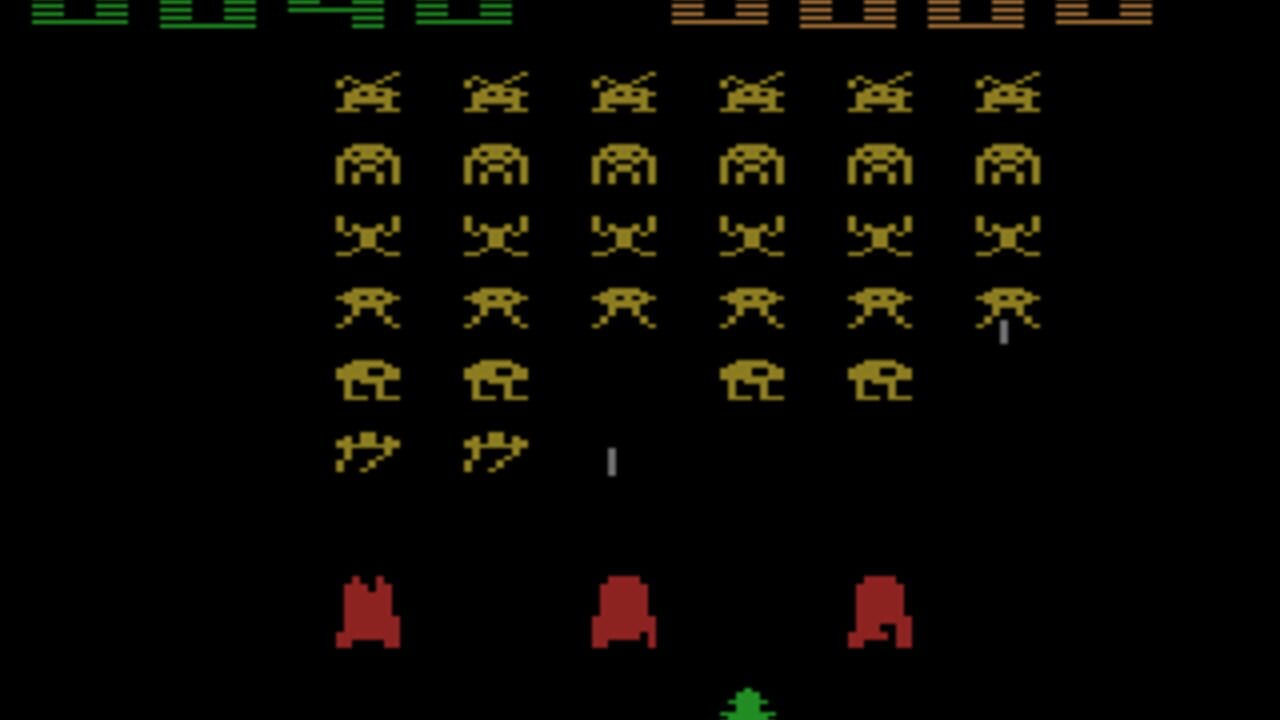
Atari won the arcade fight in 1980. The Atari 2600 version of Space Invaders was the first official licensing of an arcade game for consoles, and it quadrupled the system's sales. If you wanted the game from the arcade in your living room, Atari was the name on the box.
Pac-Man went further. It was the best-selling game on the system, with over 8 million copies sold by 1990. The Intellivision's closest answer was Astrosmash, a home-grown shooter with falling meteors that sold more than a million copies, helped by a free by mail offer for people who bought the console. It is a great game that Mattel had to give away.
The Intellivision looked better, and George Plimpton said so on TV

Mattel picked this fight on purpose. A series of ads starring the writer George Plimpton put the two consoles side by side and called the Intellivision "the closest thing to the real thing". The golf ad showed the 2600's blip sound and cruder graphics next to a realistic swing sound and a more 3D look.
The hardware backs him up. The Atari 2600 has 128 bytes of RAM and a 6507 processor. The Intellivision has a 16-bit CP1610 and 1456 bytes of RAM. Players who had both still say it was a big step up from the Atari.
The catch was speed. Almost all of Mattel's games ran on the console's built-in Exec software, at 20 Hz instead of the 60 Hz the machine was designed for. The Intellivision still wins this round, but it took its time doing it.
The Atari joystick beat the thumb-killing Intellivision controller

Atari gave you a joystick. Mattel gave you a disc that could detect 16 directions, a 12-button keypad, side buttons on both edges and two plastic overlays with every cartridge, which you slid over the keypad to show what the keys did. It looked like a TV remote and it played like a tax form.
Players still rank it among the worst controllers ever made, and thumbs are the usual complaint. One family story has a grandmother who needed thumb surgery after too many hours of Intellivision, and that is one controller review you can't argue with.
There is one good memory. Tron: Deadly Discs made you stop moving to shoot, so players picked up both controllers, one in each hand, and did both at once. It was a twin-stick shooter decades early, and your thumbs paid for it.
Nothing on the Atari touched Intellivision Baseball

Sports were why Mattel's console existed. The Intellivision stood out from its rivals with more realistic sports and strategic games, and Major League Baseball sold 1.085 million copies by June 1983. Only Las Vegas Poker & Blackjack sold more, at 1.939 million, which makes a card game the best-selling title on the console. Somebody's dad was very happy with that purchase.
Early cartridges had no room for a computer player, so many multiplayer games needed two people. That turned out to be the best thing about them. Players remember Baseball with their dad and Football at family gatherings, and some of them played for hours every day after school. If you had no brother, you had a problem.
Utopia and Dungeons & Dragons gave the Intellivision its brains

Mattel never treated the Intellivision as a toy, and games like B-17 Bomber were not built to pick up and play. You often had to read the instructions first, which no kid in a 2600 house had done since Combat.
Don Daglow's Utopia is the proof it paid off. It is often regarded as one of the first city-building games. Tom Loughry's Advanced Dungeons and Dragons was one of the most popular games on the system. Players who were small children at the time still talk about both. The Intellivision takes this one easily.
Pitfall! made the 2600 library impossible to beat

Atari's own mistake gave it the best games on the shelf. Four of its programmers asked to be treated like record label musicians, with royalties and their names on the boxes, and Atari's boss called them "towel designers". They left and founded Activision on October 1, 1979, and kept making games for the same console.
Pitfall! came out in September 1982 and held the top spot on the Billboard charts for 64 consecutive weeks. It sold over four million copies on the 2600, more than any other game there that wasn't an arcade port. The Intellivision got its own version that November, and Imagic's Demon Attack added a final boss on Mattel's machine, so its owners had nothing to be ashamed of. The 2600 still had more third-party development.
Mattel ended up selling Atari games

Mattel built simplified versions of its own games for the 2600 under the M Network name. Astrosmash went over as Astroblast, and Tron: Deadly Discs followed in January 1983.
In 1983 Mattel also sold the System Changer, an accessory that played Atari 2600 cartridges through the Intellivision. The console George Plimpton told you to buy instead of an Atari could now become an Atari. Atari wins this round without lifting a joystick.
The 2600 survived the crash and Mattel didn't

The crash of 1983 hurt both of them. In September, Atari sent 14 truckloads of unsold cartridges and other equipment to a landfill in the New Mexico desert. When the site was dug up in 2014, it held only 700,000 cartridges, which is still a lot of cartridges to bury in a hole.
Mattel had it worse. Intellivision sales fell from 1.8 million in 1982 to 750,000 in 1983, and the electronics division lost over $280 million that year. On February 4, 1984, Mattel sold the whole Intellivision business for $20 million. The console kept going under INTV Corporation until 1990, a long life for an orphan, but the 2600 stayed in production until 1992.
The 2600 is far easier to play today

You can buy an Atari 2600+, a 2023 replica that is 20% smaller and takes your original cartridges. The Atari Flashback 12 Gold has 130 games built in.
The Intellivision has that keypad problem. Players with retro handhelds say the number pad doesn't map well to normal controls, and that you want a right thumbstick standing in for it before you try. The Evercade collections of twelve games help, but you are still looking for a 12-button keypad on a modern pad. Atari takes this one.
Atari bought the Intellivision in the end

On May 23, 2024, Atari announced the acquisition of the Intellivision brand and library. Mattel spent years hiding its programmers from Atari, and Atari now owns everything they made. Night Stalker and Baseball now live at the old enemy's house.
Which one wins?
The Atari 2600 takes it on the scoreboard, with the sales, the arcade hits, the library and the longer life. Nobody who grew up with an Intellivision cares. If an Intellivision was the one in your living room, the 2600 was the other kid's toy and it always will be. Sales charts can't touch the Saturday you spent playing Baseball with your dad. The console you loved is the one you made those memories on.