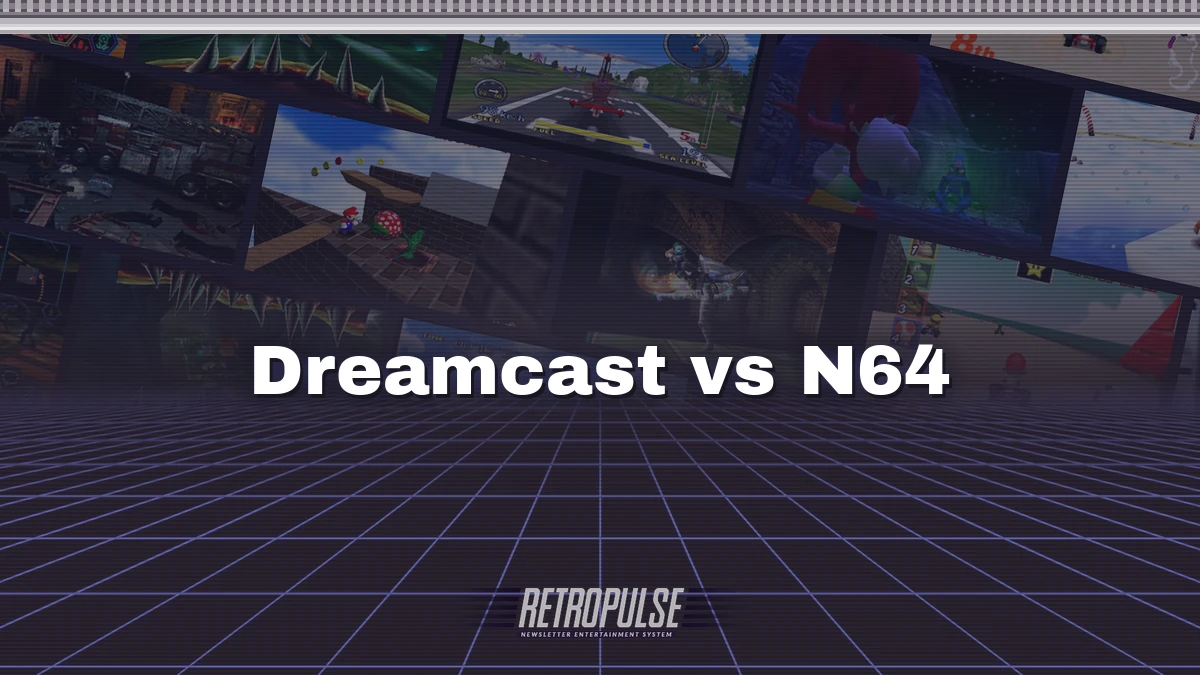
The chips inside the N64 were nearly Sega's. Silicon Graphics founder Jim Clark first pitched his video game chipset to Tom Kalinske, the CEO of Sega of America, who said he was "quite impressed". Sega's engineers in Japan rejected the design, and the idea ended up at Nintendo. Nintendo disputes that account, but Sega still had to spend the rest of the decade looking at what it turned down.
Sega got its answer on 9/9/99. By then, N64 kids had spent three years on Mario and GoldenEye, and the kid with the new white box wanted a word. Sleepovers and school buses had a new fight, and it was Dreamcast vs N64.
The N64 sold 32.93 million consoles and the Dreamcast sold 9.13 million, about three and a half to one. Dreamcast fans will tell you that means nothing, because the N64 had almost three years on the shelf before Sega showed up, and Sega quit a year and a half later. In this article we will find out who really won.
The Dreamcast won on graphics

The N64 reached North America on September 29, 1996, and the Dreamcast on September 9, 1999, so the newer console should win this, and it does. The Dreamcast's processor ran at 200 MHz against 93.75 MHz, and it had 16 MB of main memory against 4 MB, or 8 MB with the Expansion Pak. Most N64 games ran at 320×240.
Players say Dreamcast graphics were way better than anything on the N64. They also say most N64 games have not aged well, and they blame the blurry textures. Dreamcast games still look clean today, and owners recommend the VGA adapter for the best picture. An N64 through a VGA cable would only show you the fog more clearly.
The Dreamcast's discs beat the N64's cartridges

An N64 cartridge maxed out at 64 MB. A GD-ROM held 1 GB, more than 15 times as much, and it cost Sega less because it avoided the expense of DVD licensing. Players still blame cartridge storage for the N64's problems. Resident Evil 2 shows the gap. It came on two CD-ROMs on the PlayStation, and Angel Studios had to squeeze it onto a single 64 MB cartridge for the N64. It was a small miracle. The Dreamcast just put the game on discs in 2000.
The cartridge did have two wins. Players remember the N64 as instant, with no load times to sit through. Cartridges were also harder to pirate than CDs, while the Dreamcast accepted burned CDs and anyone with a CD burner had a binder full of games. That was bad news for Sega and very good news for teenagers, but the discs still take this round.
Super Mario 64 beat Sonic to 3D

The N64 wins the 3D platformer fight, and it won three years early. Super Mario 64 set many precedents for 3D platformers, and it sold 11.91 million copies. Sonic Adventure was the Dreamcast's best seller at 2.5 million, a technical showpiece that critics marked down for glitches and camera problems.
Most players say Mario 64 is the better game, and they single out Sonic's camera. A stubborn group says Sonic Adventure was better, and they are welcome to say it from inside the wall they just fell through. Sega had the newer hardware and Nintendo had the better idea.
Soulcalibur brought the arcade home

The Dreamcast wins the arcade fight without breaking a sweat. Soulcalibur holds a 98 rating on Metacritic, and its Dreamcast port added higher-resolution textures over the arcade original. Crazy Taxi reached the Dreamcast in 2000 to critical acclaim, and Marvel vs. Capcom 2 arrived the same year.
Players say no N64 game could touch what the Dreamcast did with arcade ports. Fighting game fans had it worst. Every other console got a pile of great fighters, and the N64 got ClayFighter.
The N64 owned the living room

Both consoles have four controller ports, and Power Stone 2 lets four people wreck a room on the Dreamcast. The N64 still wins this easily. Mario Kart 64 sold 9.87 million copies and GoldenEye 007 sold over eight million. Super Smash Bros. started here too, and it was at its best in four-player mode.
Players remember the N64 as the home of four-player games, and for plenty of them those games were the center of their childhood. Everyone also remembers the friend who picked Oddjob.
Nintendo and Rare made the biggest games

The N64 has the games people still build arguments around. Ocarina of Time sold 7.6 million copies and is the highest-rated game on Metacritic with 99/100, one point above Soulcalibur. Rare gave the console GoldenEye 007, Perfect Dark, Banjo-Kazooie and Conker's Bad Fur Day. One player said they would have picked the N64 for the first party and Rare games alone, and a lot of people agree with that person.
The Dreamcast's best answer was Shenmue, and it was a bold one. But for big games that everyone played, the N64 takes this round.
The Dreamcast had more to play

The N64 got 388 games. The Dreamcast got over 600 in a far shorter life. Journalist Steven L. Kent wrote in March 2001 that it was "dying now, 18 months old, with a larger library than the 5-year-old Nintendo 64", and then added, "It's a better library than the Nintendo 64."
N64 cartridges pushed third-party developers away, and players say that outside Nintendo and Rare it was slim pickings. The Dreamcast had Sega's arcade hits and a lot of Capcom's fighters. For a deep shelf, the Dreamcast wins.
The N64 was never an RPG console

This one is short, because the N64 had very little to bring. Players say it was never a platform for RPGs, and it could not follow what the SNES had done. Paper Mario and Ogre Battle 64 are lovely, and they had to carry a whole genre by themselves.
The Dreamcast has Skies of Arcadia, which is frequently regarded as one of the best games on the console, and Grandia II. Neither console touched the PlayStation here, but the Dreamcast wins this fight.
The Dreamcast put the modem in the box

The Dreamcast was the first console with a built-in modem, which added $15 to the cost of each one. That bet gave us Phantasy Star Online, the first successful online RPG on a console. Sega's servers for it ran until March 31, 2007, and hobbyists built private ones after that.
The N64's online story is Randnet, a service in Japan, and a third-party service in the US called SharkWire Online. Most N64 owners went online by walking to a friend's house. The Dreamcast takes this one.
The same game was better on the Dreamcast

Plenty of games came out on both consoles, and that makes this the fairest test in the article. Rayman 2 reached the N64 in the US on November 9, 1999, and the Dreamcast on March 21, 2000. Resident Evil 2 reached the N64 on November 16, 1999, and the Dreamcast on December 6, 2000.
Players say the Dreamcast version of a shared game usually has better graphics and a sharper picture, and they also say the N64 version is still great. A Dreamcast port got extra memory and disc space to work with, so the Dreamcast wins this round.
Both controllers are strange, and the N64's did more

Players have never settled this one. Some call the N64 pad the worst controller on a major console and say it hurt its own games. Others say the Dreamcast pad is worse, and it is hard to defend a pad with its cable coming out of the bottom. Edge called it "an ugly evolution of Saturn's 3D controller". Spin the N64 stick hard in 1998's Mario Party and you could get friction injuries, so neither side comes out clean.
The N64 wins on ideas. Its controller was the first to include a thumbstick as a standard feature. The Dreamcast pad has one stick and no camera buttons, and players still complain about it in 3D games, because the N64 at least had its C buttons. The Dreamcast has its own memory card with a screen, the 128 kilobyte VMU, plugged into the pad, and that is very cool. It does not help you look around.
The Dreamcast is easier to play today

Both consoles sit right where cheap retro handhelds start to struggle. Owners say the same device often runs the Dreamcast better than the N64, even though the Dreamcast is much stronger. Players say the N64 is hard to emulate well, even on a high-end PC.
Dreamcast fans have another trick. You can still burn a CD and put it in most real consoles, which you cannot do with an N64 cartridge. For playing old games today, the Dreamcast wins.
The N64 outlived the younger console

Sega announced the end of the Dreamcast on January 31, 2001, and discontinued it on March 31 that year. Players remember the PS2 announcement as the moment people stopped caring, and a lot of them skipped the Dreamcast to wait for it.
Nintendo discontinued the N64 in 2002, a console from 1996 that outlasted the one from 1999. In North America alone it sold 20.63 million, more than twice what the Dreamcast sold in the whole world. Sega lost a fight with Sony, and the old grey box was still on the shelf to watch.
The N64 wins on resale

Nintendo's old games hold their value, and the rare ones go far higher than anything from Sega. A loose copy of Super Bowling sells for $650, Bomberman 64: The Second Attack for $375 and Stunt Racer 64 for $323. Conker's Bad Fur Day is $169. The top of the Dreamcast list is Illbleed at $168 and Cannon Spike at $150.
The big names are closer. Ocarina of Time and Super Smash Bros. are both $50, and Super Mario 64 is $39, the same price as Sonic Adventure. Soul Calibur is $17 and Crazy Taxi is $18. Sega fans do get one upset, because Sonic Adventure 2 is $95, more than three times GoldenEye 007 at $28.
Plenty of people sold their N64 games to buy a Dreamcast, and at least one of them felt pretty dumb about it later.
Which one wins?
The Dreamcast wins on paper. It has the better hardware and it took more of the rounds in this article. It doesn't matter. If an N64 was the console you and your cousins fought over, or a Dreamcast was the last Sega you ever owned, that console is yours for good. The memories you made with it are what made it special, and a spec sheet has no column for those.