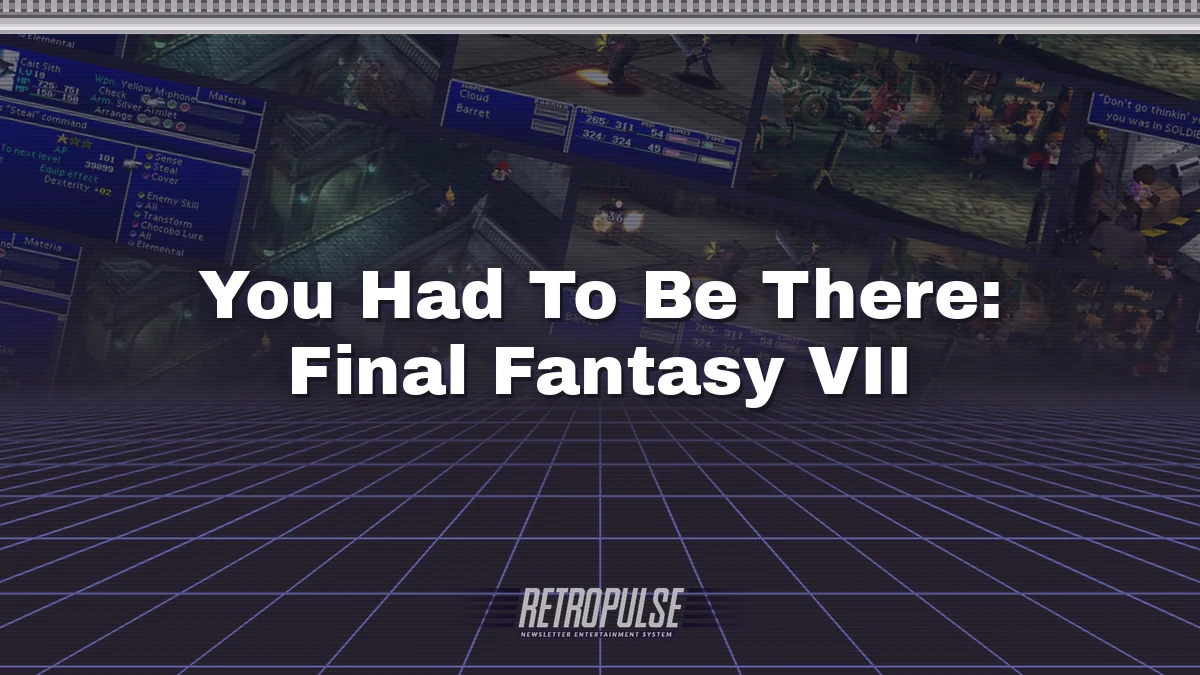
Final Fantasy VII was originally going to be a detective story set in New York City in 1999, starring a character called Hot Blooded Detective Joe. At one point the writers planned to kill off most of the main cast just before the final battle, until character designer Tetsuya Nomura vetoed it because he felt it would undermine the impact of Aerith's death.
What shipped instead became the game a whole generation measures every other one against. To see why, you need to stand where we stood in 1997.
A demo on a disc
First, understand how a demo reached a kid in 1997. You didn't download it. Demos came on CDs, often stuck to the front of a gaming magazine, so you paid at the newsstand for a disc you couldn't see, and the cover disc lottery was a real monthly event. Some months you got racing games you would never touch. Some months you got Final Fantasy VII.
Square started early. A playable demo was handed out on a giveaway disc at the 1996 Tokyo Game Show, called Square's Preview Extra: Final Fantasy VII & Siggraph '95 Works, and it also carried the early test footage Square had made with characters from Final Fantasy VI. In North America and Japan, every copy of Square's fighting game Tobal No. 1 came with a sampler disc holding a playable demo of Final Fantasy VII, so plenty of kids bought a fighting game to get a role-playing game. Whichever disc it reached you on, the hook was the first battle: the camera swooped, the screen erupted in light and a spiky-haired swordsman struck a pose like a manga cover come alive. The way I remember it, a monster that looked like a Chinese dragon coiled onto the screen right before all that, and my jaw went to the floor and declined to return. I replayed that demo more times than most full games I owned.
Square left Nintendo for this
The best-looking Final Fantasy in existence was VI, a Super Nintendo game made of flat sprites the size of your thumbnail. That was the ceiling. To go past it, Square had to leave the company that had been its home since the beginning.
Square did test a Nintendo 64 version. It would have needed an estimated thirty 64DD discs to run properly with the compression of the day, and cartridge games kept getting more expensive. A PlayStation CD could hold 650 MB, while cartridges topped out at 64 MB. Impressed by how much more a CD-ROM could hold, Square moved Final Fantasy VII, and every other project it had planned, onto the PlayStation.
The ads did not let anyone forget it. One read "Someone please get the guys who make cartridge games a cigarette and a blindfold." Another claimed that if the game were available on cartridge, it would retail for around $1,200. Subtle, it was not.
The money matched the swagger. Development cost an estimated US$40 million, and the team of between 100 and 150 people was described as the largest of any game up to that point, at a time when most teams were about 20 people. Marketing cost another US$40 million worldwide, $20 million of it in North America, where a TV commercial ran alongside Saturday Night Live and The Simpsons.
The ceiling wasn't raised, it was deleted

It was the first Final Fantasy with full motion video and 3D graphics: polygon characters walking across painted, pre-rendered backgrounds, and CG cutscenes that looked like they had escaped from a movie studio. We knew the backgrounds were paintings. Nobody was fooled, and nobody cared, because a CRT's soft glow blended painted city and polygon hero into one dreamlike picture, and because the battles were fully 3D and absurdly over the top.
Even with all that room, the game shipped on three discs, and every inch of it was still a squeeze. The early tech demo had been built on a machine with over 400 megabytes of memory. The PlayStation had two megabytes of system memory and 500 kilobytes for textures. Nomura designed Aerith's dress to use as few polygons as possible, and Cloud was first drawn with slicked-back hair for the same reason before he got the spikes.
Then there was the Buster Sword. Look at it today and you see a sword shaped like a door. In 1997 there was no convincing anyone it was not the coolest sword ever made. It began much smaller, with one Materia slot, and Nomura called his early version "the Giant Kitchen Knife." His first design even showed how it stayed on Cloud's back: a magnet held by his straps. Midgar got the same care. Art director Yusuke Naora pictured the city as a pizza while designing it, which is why one of the slum tracks is called "Underneath the Rotting Pizza."
Two million in three days
Final Fantasy VII came out in Japan on January 31, 1997, and sold over two million copies in its first three days. When it reached North America on September 7, 1997, thousands of retailers broke the street date to keep up with demand. It sold 330,000 copies in its debut weekend there and one million by early December. In November it became the first Final Fantasy ever released in Europe.
By the end of 2005 the PlayStation version had sold 9.8 million copies, the most of any game in the series, and it passed 10 million by May 2010. It is also credited with giving console role-playing games mass-market appeal outside Japan.
Nobody understood the story, everybody understood Sephiroth
The honest confession every veteran will sign: I had no idea what the story was about, and neither did most of us. Clones, false memories, a corporation draining the planet, a flashback told by an unreliable narrator. Critics now compare it to films like Fight Club and The Sixth Sense, which tells you how confused we were allowed to be at twelve.
It didn't matter, because everyone understood Sephiroth. Long silver hair and an even longer sword. Nomura said he pictured Cloud and Sephiroth as Musashi Miyamoto and Sasaki Kojiro, the famous swordsman rivals, and designed both men and their swords around that. Sephiroth's past was rewritten more than once, too. Aerith was at one point going to be his sister, which is why her hair looks the way it does, and the team later made him her old flame before swapping him for Zack. Even the ending kept faith with the idea: in the final one-on-one duel, Sephiroth has exactly 1 HP, so a single hit always finishes him.
The death you already know about
There is a moment in this game nobody needs a spoiler warning for anymore. You know. Everyone knows.
We didn't. The idea came from the top: creator Hironobu Sakaguchi had lost his mother while Final Fantasy III was being made, and he wanted a game that did not just make life its theme. In his words, "you need to portray death." Director Yoshinori Kitase wanted it sudden and unexpected, leaving "not a dramatic feeling but great emptiness."
It worked so well that people refused to accept it. From the game's release, rumours circulated that Aerith could be brought back, or that a cut ending once revived her. With no wiki and no patch notes to check, the playground filled the gap with secret methods and cousins who had done it. I wasn't above any of it. I once translated a long French forum post by hand, dictionary open, truly believing the instructions at the end would unlock Zack. Nomura later said flatly that none of it was ever true. Japanese players even sent Kitase a long petition asking for her revival, and he turned it down.
And then the choir started
Nobuo Uematsu scored the whole thing, and he had more to work with than ever: the PlayStation had 24 sound channels where the Super Nintendo had eight. Aerith's Theme did half of our mourning for us.
Then, at the other end of the game, the final boss descended and a choir began chanting in Latin. "One-Winged Angel" was the first track in the series with high-quality digitized vocals, and its lyrics came from the medieval poetry behind Carl Orff's Carmina Burana. Uematsu said the opening was based on Jimi Hendrix's "Purple Haze." To us it sounded like the game had outgrown games entirely and was borrowing gravity from church.
There was nothing like it
The sentence that mattered on the playground was simple: there was nothing like it. Today a cinematic game is a Tuesday. The category is full partly because Final Fantasy VII created the demand for it. In 1997, watching Cloud strike a pose while a summon filled the television, you were looking at something with no shelf to put it on. The feeling was never that this was a great game. It was that you had not known this was allowed.