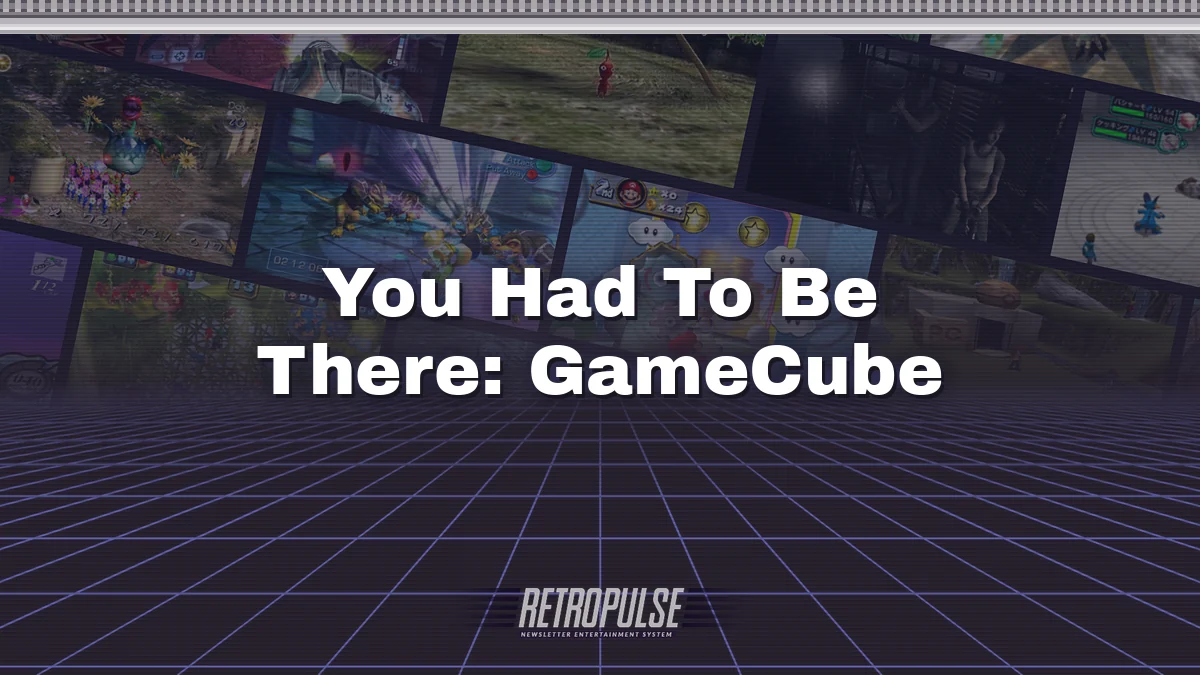
The GameCube went through a pile of names before it got its real one. Inside Nintendo it was N2000, then Star Cube, then Nintendo Advance. In May 1999 Nintendo announced it to the world as Dolphin, the successor to the Nintendo 64, with a PowerPC processor from IBM codenamed Gekko. The name GameCube only arrived at a press conference in Japan on August 25, 2000, and Nintendo made a show of it. On stage, the company explained that Dolphin had only ever been a code name. Two associates wheeled out a giant box while air jets blew fog all around it. Then explosions went off, and five women stepped out of the box, each holding a GameCube.
Here is the part nobody knew back then. Long before launch, Nintendo built and patented an early prototype of motion controls for the GameCube, and the developer Factor 5 experimented with it for its launch games. The idea went back in a drawer. It would come out again five years later and change everything, but that is another console's story.
A purple box with a handle

The PlayStation 2 and the Xbox looked like hi-fi equipment. The GameCube looked like something you would find in a toy shop, and it was proud of it. It launched in Indigo, the purple you saw in every advert and on the logo, and in Jet Black for the people who were embarrassed. A Platinum model followed a year later, and Japan got an orange one called Spice.
It also had a carrying handle on the back. The idea was to make it easy to move around Japanese homes, from the living room TV to a bedroom. In the West it gave the impression of a Fisher-Price toy, which was the last thing self-conscious gamers wanted while everyone else played DVDs and grown-up games on a PS2 or Xbox. Critics praised the controller and the games and then complained about the toy-like design, and later reviews kept calling it "toy-ish". We did not care. You could carry it, and that was the point.
The discs were tiny. Nintendo had finally given up on cartridges, but instead of normal DVDs it used its own 8 cm discs, designed by Matsushita with their own copy protection and holding about 1.5 GB. The PlayStation 2 and Xbox used discs that held up to 8.5 GB. The GameCube could not play your DVDs or your CDs. It played games, and nothing else.
Then there was the controller. Shigeru Miyamoto started by redesigning the face buttons, and the result put a large green A button in the middle so your thumb knew where home was. Around it sat a smaller red B button and two kidney-shaped buttons for X and Y. One of the console's hardware designers, Kenichiro Ashida, said it was meant to be so intuitive that the player would forget they were holding it. It looked ridiculous. It felt perfect.
$199 and no Mario
The GameCube came out in Japan on September 14, 2001, in North America on November 18, 2001, and in Europe on May 3, 2002. It cost ¥25,000 in Japan and $199 in the US, which was $100 lower than the PlayStation 2 and Xbox. Nintendo spent $76 million marketing it, with ads that said "Born to Play" and ended with a spinning cube and a voice whispering "GameCube."
Japan sold between 280,000 and 300,000 consoles in the first three days, out of 450,000 shipped. In North America, $100 million worth of GameCube products sold over the launch weekend. Europe got the strangest launch of all: Nintendo announced a price cut almost two weeks before the console even went on sale there, setting a new price of 199 euros.
And there was no Mario. The GameCube was the first Nintendo home console since the Famicom without a Mario game at launch. Instead we got his brother with a vacuum cleaner.

Luigi's Mansion had started life as a tech demo at Nintendo Space World 2000, built to show off what the new hardware could do. Nintendo took criticism for launching with it instead of a 3D Mario game, and fair enough, it was short. It still sold over 3.3 million copies and became the fifth best-selling GameCube game. It was even supposed to be in 3D. Nintendo built stereoscopic 3D technology for the GameCube and only Luigi's Mansion supported it, but the add-ons would have cost too much and almost nobody owned a 3D television.
Melee ate our weekends
Two weeks after the American launch came the real reason to own one. Super Smash Bros. Melee arrived in North America on December 3, 2001, and sold 250,000 copies in nine days. It became the best-selling GameCube game, with over seven million copies sold by 2008.
This is where the controller became a legend. Nintendo has supported the GameCube controller on every home console it has made since. It kept making Platinum ones in North America until around early 2012, and in 2014 it released a new Smash Bros. edition to go with Super Smash Bros. for Wii U. A controller designed for 2001 was still being sold to people who refused to play Smash with anything else.
The year of Celda

At Space World 2000, Nintendo showed a short clip of a grown-up Link fighting Ganondorf. The Zelda team had made it in a hurry, purely as a demonstration. Nobody told us that. We watched it, we saw the next Zelda, and we spent a year waiting for it.
At Space World 2001, Nintendo showed the real game, and it was a cartoon. Some people loved the cel-shaded look. A lot of fans who had hoped for a more realistic Zelda did not, and critics called it "Celda." Miyamoto was surprised by the reaction and decided to hold back further information until there was a playable demo. The backlash was instant, and that turned out to be the last Space World event. When The Wind Waker came out it sold 4.6 million copies, far below the 7.6 million of Ocarina of Time, so the next Zelda, Twilight Princess, went realistic. Wind Waker's reputation improved over time, and today it is considered one of the greatest video games ever made. Sorry, Celda. We were wrong.
The weird stuff we remember
The GameCube had a talent for strange moments.
At Space World 2000, Nintendo also showed a tech demo called Super Mario 128. It never became a game, but Melee later named a battle stage after it, where you fight 128 tiny Mario figurines. In 2007, Miyamoto told a room full of developers that the one question he always got was what happened to Mario 128. His answer: "Most of you already played it ... in a game called Pikmin".
In Japan, the TV commercials for Pikmin used a song called "Ai no Uta", sung from the point of view of the little plant creatures. It reached number 2 on the Oricon chart and sold 900,000 copies by June 2002. A song sung by tiny plant soldiers was one of the biggest singles in Japan that year.
Animal Crossing ran on the GameCube's internal clock, so the town kept living while you were at school. If you switched off without saving, a mole called Mr. Resetti turned up outside your house the next time and scolded you through a long conversation you could not skip. A whole generation learned to save because of a mole.
Eternal Darkness had "sanity effects" that broke the fourth wall. One of them told you your memory card was being formatted, and players who panicked and pulled the card out could damage it for real. Nintendo patented the sanity system in 2005.
Capcom promised the GameCube five exclusive games. Resident Evil director Shinji Mikami said he would "cut his own head off" if Resident Evil 4 came out on another platform. Two months before its January 2005 release, Capcom announced a PlayStation 2 port. (Mikami kept his head. The phrase means quitting your job in Japan.)
Small, purple and loved anyway
The GameCube struggled. Nintendo stopped making it for the first nine months of 2003 because millions of unsold consoles were sitting in stock, then dropped the price to $99.99 on September 24, 2003. A Time International article called it an "unmitigated disaster." Satoru Iwata had told investors Nintendo would sell 50 million by March 2005. By the end of 2006 it had sold 21.74 million, fewer than half.
But the people who owned one bought games for it like nobody else. The GameCube had the highest attach rate of any Nintendo console at 9.59 games per console, and it was profitable. The original version of its successor, the Wii, played GameCube games, with GameCube controllers and memory cards too. That's the GameCube: a purple box with a handle that lost the war and won every Friday night.