The Nintendo 64 started life on a supercomputer. Silicon Graphics, a long-established leader in high-performance computing, wanted to shrink its technology into something cheap enough for a living room, and on August 23, 1993, it announced a deal with Nintendo called "Project Reality." Before the hardware was finished, developers built games on an SGI Onyx priced at up to $250,000.
SGI had first pitched the idea to Sega. Sega of America's boss said they were "quite impressed." Then Sega's Japanese engineers turned it down. That is one of the great what-ifs in console history, and it is not even the strangest thing about this machine.
Ultra 64, and then just 64
On June 23, 1994, Nintendo announced the console would be called the "Ultra 64." The arcade version of Killer Instinct ran on related hardware, and its attract mode promised the game would be "available for your home in 1995 only on Nintendo Ultra 64." It was not. The final name, Nintendo 64, was suggested by Shigesato Itoi, the creator of EarthBound. The old name lived on in the console's model numbers, which start with "NUS-."
The finished console was shown in playable form at Nintendo's Shoshinkai show on November 24, 1995, with "hordes of Japanese schoolkids huddled in the cold outside." Then the release date slipped to April 21, 1996, and then again. To stop people buying a Saturn or a PlayStation while they waited, Nintendo ran ads with slogans like "Wait for it..." and "Is it worth the wait? Only if you want the best!" Bold, for a company asking you to sit on your hands for a year.
Sold out on day one

Japan got it first, on June 23, 1996. The first shipment of 300,000 units sold out on the first day, and Nintendo dodged the launch-day chaos of the Super Famicom partly by selling through convenience stores as well. In the months before America got it, import shops in the US charged as much as $699 plus shipping for a Japanese console.
North America was told September 29, but shops started selling it on September 26, 1996. The price was US$199.99, down from a planned $250, because the Saturn and PlayStation had both dropped to $199.99 that summer. Nintendo priced it like a toy, as an impulse purchase. Retailers sold 350,000 of their 500,000 units in the first three days.
There were exactly two games: Super Mario 64 and Pilotwings 64. Cruis'n USA was pulled less than a month before launch for not meeting Nintendo's quality standards. Nintendo of America's chairman Howard Lincoln had explained the thinking back in 1994: "we're convinced that a few great games at launch are more important than great games mixed in with a lot of dogs." People still bought Pilotwings 64 with roughly one in every four consoles.
A Cabbage Patch frenzy
By Christmas it had become the toy. Time called the buying "that rare and glorious middle-class Cabbage Patch-doll frenzy." It reported that celebrities including Matthew Perry and Steven Spielberg called Nintendo asking for special treatment to get one. So did Chicago Bulls players. If you were a regular family without a famous phone number, good luck.
Nintendo backed the American launch with a $54 million marketing campaign. Where the Saturn and PlayStation went after teenagers and adults, the Nintendo 64 aimed at pre-teens, and the American slogan was "Get N or Get Out." In Japan, the ads said "The game changes, 64 changes."
The most famous Nintendo 64 moment of all didn't come from an ad. On Christmas morning in 1998, a boy unwrapped a Nintendo 64 and completely lost his mind on a family camcorder. The clip went online on March 26, 2005, and the "N64 kid" became shorthand for wanting a console more than anything in the world.
Mario in three dimensions
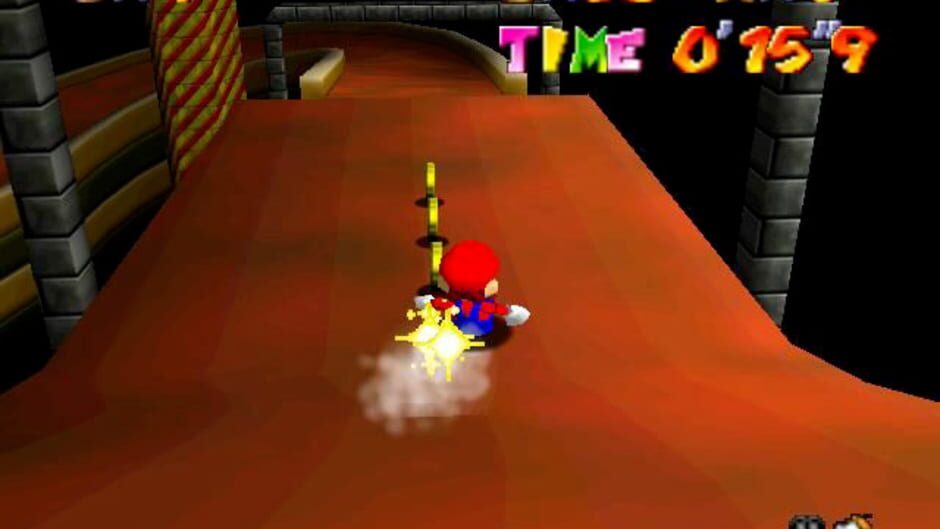
Super Mario 64 was why you wanted one. It sold more than two million copies in its first three months in North America and became the best-selling video game of 1996 by dollar sales. It went on to be the best-selling Nintendo 64 game, with 11.91 million copies by 2015.
It needed a new kind of controller, and it got one. The Nintendo 64 pad was shaped like an M, with three handles, and it made Nintendo the first company to put a thumbstick on its main controller as standard. Popular Electronics said it looked "evocative of some alien spaceship" and admitted the three handles could be confusing. It liked the idea anyway: "the separate grips allow different hand positions for various game types." In practice you held two handles and the third one just sat there, pointing at you.
The cartridge problem
The big gamble was the cartridge. Everyone expected Nintendo to follow the PlayStation onto CDs, and when the first prototypes appeared in November 1995, observers were surprised to see cartridges again. They loaded almost instantly and were hard to pirate. They also held 64 MB at most against a CD's 650 MB. Each production run took at least two weeks, and games cost about US$10 more than on PlayStation.
That cost Nintendo dearly. Square and Enix had planned to put Final Fantasy VII and Dragon Warrior VII on the Nintendo 64 and moved them to Sony's console because of the storage limits.
The Jolting Pak
Then Nintendo found a new way to sell the controller. At the 1996 Shoshinkai show it announced the "Jolting Pak" (soon renamed the Rumble Pak), which IGN called "the biggest surprise" of the show. It came bundled with Star Fox 64. Plug it into the controller and every crash and laser hit shook in your hands. Rumble is everywhere now. It started as a little brick that ran on its own batteries.
Nintendo kept finding odd ways to reach kids. In early 1999 it teamed up with General Mills on Fruit by the Foot snacks that carried tips for Nintendo 64 games, with ninety different tips to collect. You learned the secrets of your favourite game by unrolling a strip of fruit leather.
Four controllers, one television
The Nintendo 64 was also one of the first consoles with four controller ports built in. Shigeru Miyamoto said Nintendo included them because it was the first console powerful enough to run four-player split-screen without serious slowdown. That one decision built the sleepover.
GoldenEye 007 is the proof. It faced low expectations from the gaming press while it was being made, and its multiplayer let up to four players fight deathmatches in split-screen. It sold more than eight million copies, behind only Super Mario 64 and Mario Kart 64 on the console. Four friends crowded round one small television, each pretending not to look at the others' quarters of the screen, is the image of this console for a lot of us.
The Nintendo 64 sold 32.93 million units. It owned the living room floor on weekends. You just had to have enough controllers.