Sony announced its next handheld on January 27, 2011, under a code name that sounded like a filing cabinet: "Next Generation Portable" (NGP). It aimed for PlayStation 3 quality visuals. Then a Sony platform research manager named David Coombes had to walk that back, and he did it beautifully: "Well, it's not going to run at 2 GHz [like the PS3] because the battery would last five minutes and it would probably set fire to your pants."
So it was not a PS3. Sony's engineers put its power about halfway between the PSP and the PS3, which was still absurd for something you could hold. The PSP had kicked the door down. This was the machine that was supposed to move in and redecorate.
A console with a touchpad on its back

In December 2010, Sony's Kazuo Hirai said the plan was to reach everybody at once: buttons and joysticks for traditional handheld players, and touchscreens for smartphone users. The NGP took that literally. It had a 5-inch OLED touchscreen, two analog sticks, physical buttons and a rear touchpad, so you could poke the back of the console while your thumbs were busy on the front. The pitch was "the best of both worlds."
At E3 on June 6, 2011, it got its real name. PlayStation Vita, with "vita" being Latin for "life." Mark Cerny, later the lead architect of the PS4, was the lead architect. The screen ran at 960 × 544, and on the original model it was an OLED panel that made colours look wet. Two cameras sat on it too, front and back, both 0.3 megapixel. Nobody bought a Vita for the cameras, and the cameras seemed to know it.
Then Kaz Hirai got to the price. The Wi-Fi model would be $249 and the 3G/WiFi model $299. Five years earlier the PS3 had launched at a price people still joked about, and Sony's Jack Tretton admitted on that same stage that he was "tempted to bust out that Ridge Racer line." He didn't. Engadget's live blog summed up the room: "If you were wondering if Sony learned its lesson from the PS3, we think you've got your answer."
The PSP's discs were gone. Games came on little cards of 2 GB or 4 GB, about the shape of an SD card, and there was a 3G model if you wanted to pay a phone company as well. In the US that meant AT&T, and in Japan NTT DoCoMo. AT&T's cheapest plan was $14.99 for 250MB, which in 2012 felt like a lot of internet and was not.
Three hundred thousand, then a cliff
When pre-orders opened in Japan on October 15, 2011, hundreds of people waited outside the Yodobashi Camera store in Akihabara. According to the Nikkei, there were 1,200 people in line by 7am.
The Vita launched in Japan on December 17, 2011, with 26 titles. America and Europe followed on February 22, 2012, with 25, although a limited edition reached North America a week early on February 15. It held the 3G/Wi-Fi model, the game Little Deviants, a carry case and a 4 GB memory card. The basic price in the US was US$249.99.
Japan bought more than 300,000 in the first week. That is a good week. The second week dropped 78% to under 73,000, and then sales settled at about 12,000 a week. In the United States it sold 200,000 in its first month and then slid to about 50,000 a month. Sony reported 1.2 million units sold by February 26, 2012, after it had launched in most regions. Sony wanted 10 million Vitas sold by the end of March 2013 and fell far short.
Sony's first American TV ad carried the tagline "Never Stop Playing." Kotaku pointed out that you probably should stop at some point, "To eat. And sleep." If you bought one at launch, you didn't feel any of that. You felt like the owner of the nicest screen in the room.
Poking the back of a console
The launch games had one job, which was to justify every input on the thing. Little Deviants was 30 minigames built around the front touchscreen, the rear touchpad, the motion controls and augmented reality, with the regular buttons left out apart from the L and R triggers. It was a tech demo in a party hat.
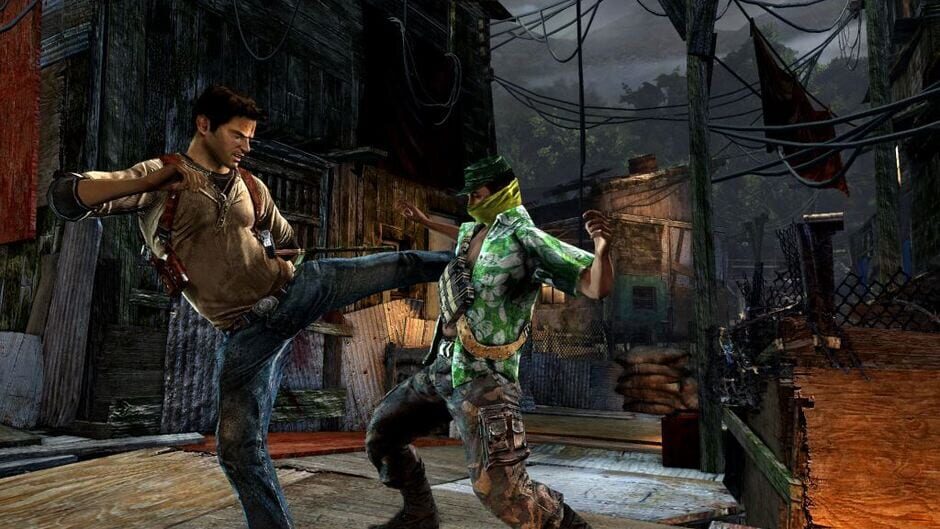
The real showpiece was Uncharted: Golden Abyss. Sony had asked Bend Studio for a new Uncharted as a launch title back in 2007, and because the Vita's specifications kept changing, much of the early work was done on PlayStation 3 hardware. You tilted the console to balance Nathan Drake on a tightrope, and you swiped the screen to throw a punch, because swiping was mandatory for melee attacks. Watching Drake climb a jungle temple on a handheld was the moment the whole NGP pitch made sense.
The rear touchpad never found its calling. Years later, Sony's own Shuhei Yoshida said it was not used by many games, and that it "just added more costs for the consumer."
The memory card tax
Then there was the card you needed before you could do much of anything. The Vita would not take normal SD cards. It took Sony's own memory cards, in sizes of 4 GB, 8 GB, 16 GB, 32 GB and 64 GB, and the prices made adults wince.
Engadget called them "outrageously priced." GameSpot said the price was "grossly inflated." The Verge called it "extraordinarily high" next to common SD cards. Yoshida eventually agreed that they were "incredibly expensive." That is an unusual thing for a company to say about something it sold.
There was a second, sillier limit. At first the Vita could hold only 100 applications and games at a time, however much space you had left, and you had to delete or move something to get past it. System software 3.10 raised that to 500 in 2014.
A handheld that knew where you were
Sony dropped the PSP's menu for LiveArea, a touch interface where every game got its own little page of updates and social features. It also shipped an app called Near, which showed you other Vita players in the area and what they had been playing. It was a lovely idea, and most of it was switched off in 2015.
The Vita also tried to be your phone without being your phone. There were apps for Netflix and Crunchyroll, and Skype ran on it until it was removed in 2016. Later, almost every PlayStation 4 game could be streamed to it over Remote Play, so the handheld became a second screen for the console under the television.
Monster Hunter left, the indies moved in
What hurt most was who didn't show up. Monster Hunter had boosted the PSP enormously, and Capcom took the series to the Nintendo 3DS instead, where it sold millions of copies for Sony's main rival. Big Western publishers like Ubisoft and Activision started cutting back too.
So Shahid Ahmad, Sony's Director of Strategic Content, started knocking on the doors of small independent developers. It worked better than anyone expected. Fez, Spelunky, Hotline Miami and OlliOlli all found success on the Vita, and Ahmad talked to players directly on social media. Tales of Hearts R was localized into English only because it came first in a survey of games people wanted on the platform.
In Japan it never needed rescuing in the same way, because Japanese studios kept feeding it role-playing games and visual novels. Freedom Wars sold over 188,000 copies in its first week there. Minecraft, of all things, sold over 1.2 million physical copies in Japan alone by September 2017.
Slimmer, cheaper and not quite as pretty
In August 2013 Sony cut the price to $199 in North America and €199 in Europe, and cut the price of the memory cards. The PCH-2000 redesign that came with it was 20% thinner and 15% lighter, added 1 GB of internal storage and about an extra hour of battery. It also swapped the OLED screen for a cheaper LCD. People who had fallen in love with that first screen noticed immediately.
Production of Vita hardware ended on March 1, 2019. By September 2018 USgamer estimated about 16 million units sold, against an estimated 80 million for the PSP. In a 2021 look back by The Verge, former Sony director Christian Phillips admitted they had seen smartphone gaming as "just good enough for gameplay." The phones were better than good enough, and they were already in everybody's pocket.
Sony tried to close the Vita's online store in 2021 and reversed the decision after the backlash. On July 1, 2026, it announced the store would shut down for good, with the doors set to close in July 2027. Vita means life. For a console that kept getting written off, it has had a very long one.