The PSP almost shipped without an analog stick. The concept images Sony showed at a corporate strategy meeting in November 2003 had flat buttons and nothing for your thumb to push, and reviewers worried out loud. By the time Sony unveiled the real thing at E3 2004, the stick was there, along with a list of 99 developer companies that had promised to make games for it.
Sony's boss Ken Kutaragi had already called it the "Walkman of the 21st century." That tells you what kind of object it was meant to be. The easiest way to explain the PSP is this: it was to handhelds what the original PlayStation was to the Super Nintendo.
A PlayStation that fit in a jacket

Before the PSP, Nintendo had owned handhelds since the Game Boy in 1989, and the challengers had mostly bounced off. In 2004 one industry analyst called the PSP the "first legitimate competitor to Nintendo's dominance in the handheld market." Holding one, you could see why.
The PSP did not feel like the next handheld. It felt like hardware smuggled back from a few years in the future. The glossy black shell and the 4.3-inch widescreen at 480 by 272 pixels made it look like something an adult with too much disposable income would own. Engadget called it "definitely one well-designed, slick little handheld." PC World grumbled about the glare and the smudges from all that gloss, and nobody who owned one argued.
If you look at that screen now, you can see the pixels. Fine. Back then it was full HD in our minds, the most beautiful display we had ever seen on a handheld.
Inside were two 333 MHz processors, which Sony quietly held to two-thirds of their full speed for the first few years to save the battery. The disc drive was the other battery hog, and slow to read, so developers had to lay out their game data carefully to keep loading times down.
Sold out in three hours
The PSP launched in Japan on December 12, 2004, at ¥19,800 for the basic model, and sold over 200,000 units on the first day. North America got it on March 24, 2005, in a single bundle for US$249, which was almost US$20 more than in Japan and over $100 more than a Nintendo DS. Early American boxes came with Spider-Man 2 on a tiny movie disc. Sony said 500,000 units sold in the first two days anyway.
Europe was supposed to launch at the same time and got pushed back because Japan and America were buying them all. When it finally arrived on September 1, 2005, at €249 or £179, the UK's stock sold out within three hours. That was over 185,000 units, more than doubling the first-day record of 87,000 set by the Nintendo DS.
It made the old handhelds look like toys
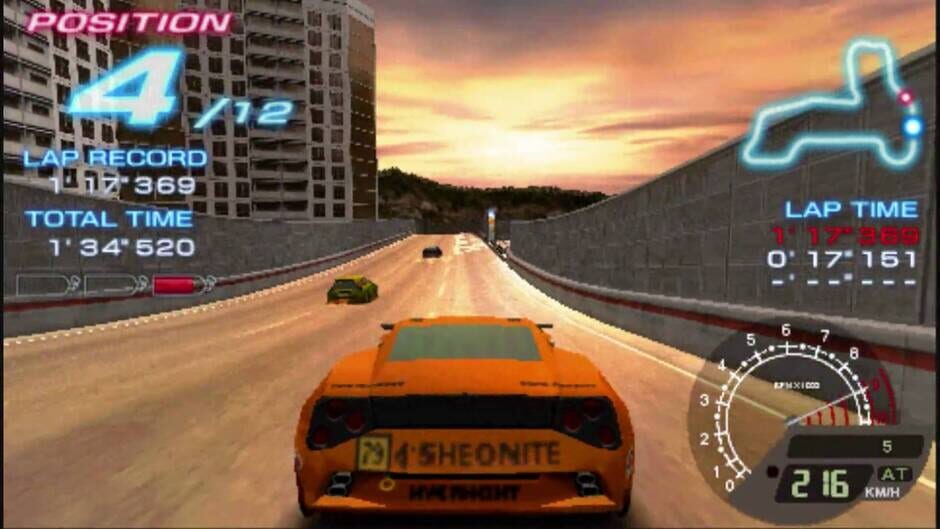
The PSP was not just stronger than the Game Boy Advance. It made the whole old model feel quaint. I love the GBA, but next to the PSP it looked like a toy. The best example was Ridge Racer, which moved so fast and looked so crisp that it felt impossible. You showed it to somebody for ten seconds and watched their brain try to accept that this was happening on a handheld.
It was a portable PlayStation, and that pitch was true. From firmware 3.00, digitally released PSone Classics became playable on it, so actual PlayStation games ran in your hands at a time when that still felt illegal.
To be fair to the other side, power did not win the war. The DS attracted more third-party developers and appealed more to casual players, and over their lives the PSP sold 80 million fewer units than the DS. That doesn't change what it felt like to hold one.
Games that climbed back up to the big consoles
What still gets us is how hard developers pushed it. Metal Gear Solid: Peace Walker is the monument here. During planning it was known as Metal Gear Solid 5: Peace Walker, and Hideo Kojima considered it the biggest game he had ever worked on. In 2011 it got an HD version for the PlayStation 3 and Xbox 360, because a game that size was never going to stay on a handheld.
Monster Hunter Portable 3rd sold 2.58 million units in Japan within two weeks, which Capcom called the fastest-selling game in its history, and it reached 4.8 million by June 2011. Grand Theft Auto: Liberty City Stories became the best-selling PSP game, with 7.5 million copies by July 2013, and it was ported up to the PlayStation 2 on June 6, 2006. These games were not good for a handheld. They were good, full stop.
In total, 1,370 games came out for the PSP between 2004 and 2016, and in 2009 Sony added PlayStation minis, smaller digital-only games that felt like an early indie aisle before that word became its own giant section of the industry.
Movies on tiny plastic discs
The PSP played music and video, and Sony gave it its own disc for both. The Universal Media Disc held up to 1.8 gigabytes and carried feature-length films as well as games. Watching Spider-Man 2 on a disc smaller than a coaster, on a device the size of a wallet, is objectively insane. At the time it felt futuristic, or futuristic enough that we forgave the insane part.
The catalogue got strange fast. The BBC put The Office and Doctor Who out on it, and WrestleMania XXIV became the only WWE pay-per-view ever released on the format. Then the format faded, and the last Japanese factory making UMDs closed in late 2016.
A little black portal to the internet
Over time it learned to reach into a PlayStation 3 from across the house, or across the internet, through Remote Play. From system software 3.90 the newer models could even make Skype calls over Wi-Fi. Today that sounds normal because your phone has eaten the whole category of wonder. Back then it was a genuine flex.
People also made it do things Sony never wanted. On June 15, 2005, hackers took apart the PSP's code and put it online, and soon modified consoles were running homemade programs, starting with things as humble as a calculator or a file manager. Sony answered with update after update, and the hackers kept answering back.
The ads tried very hard
Sony marketed it as lifestyle hardware, not a toy for the back seat, and sometimes it tried too hard. I remember Gary Dourdan from CSI holding it like a premium object, which was the whole pitch: handheld gaming after it had discovered cologne and self-respect. In late 2005 it hired graffiti artists to spray-paint PSP ads in seven major U.S. cities, paying building owners for the walls. A year later a poster in Manchester saying "Take a running jump here" was pulled from a tram platform over fears it might encourage suicide.
The strangest one came in December 2006. A blog called alliwantforxmasisapsp.com claimed to be two friends dropping hints to one friend's parents, written in deliberate misspellings: "a psp would be teh perfect gift." Critics found the site's registration data and traced it back to Zipatoni, an advertising firm working with Sony.
The moment handhelds started dressing like the future
The PSP sold 76.4 million units by March 31, 2012. The later PSP Go was 43% lighter and 56% smaller than the original, and the line ran until shipments ended worldwide in 2014. The last physical games came out in April 2016.
The original PlayStation made gaming feel older and moodier. The PSP did the same for portables. It said handheld gaming did not have to look like a toy, and it gave teenagers and grown-ups who still played a machine they were proud to pull out on a train. The Vita may be my favourite handheld, but the PSP is the one that kicked the door down.