Snake started life as a failed Tetris clone. Taneli Armanto, part of the interface team at Nokia, first tried to build a Tetris-like game for the new Nokia 6110 before switching to the snake idea he knew from older computer games. Along with the other games on that 1998 phone, it was the first video game released with sound for a mobile phone.
According to Nokia, 350 million copies of Snake exist in some form, and Armanto thinks the real number is higher. Nokia ran two Snake Finnish Championships at the turn of the millennium. In Australia, 30 players reached the highest score possible, 2,008 points on the hardest setting. In November 2012 the Museum of Modern Art in New York added it to its collection.
That was the warm-up. What came next was a whole games industry living inside phones that could barely hold a photo.
A game console you already owned
If you grew up with an app store, you have never had to wonder whether your phone could run a game. Back then the answer came down to one word on the box: Java. Sun announced the mobile version, Java 2 Platform, Micro Edition, on June 15, 1999, and the first commercial software and hardware arrived in 2001. The Siemens SL45i, that same year, was the first phone that could run it.
The pitch was write once, run anywhere, and it came with highly compressed file sizes, which made it perfect for little games. The 2.0 version of the phone profile, approved on November 20, 2002, added a basic 2D gaming API, and developers piled in. Nokia's first Series 40 phone, the 7210 from 2002, gave them a 128x128 pixel colour screen to work with, which is smaller than a single app icon on your phone today.
It spread everywhere. By 2013 there were more than three billion phones that could run Java ME, even as smartphones pushed it into decline.
Console games, shrunk to fit a keypad
The big studios came quickly. Gameloft, founded in Paris on 14 December 1999 by Michel Guillemot, made the mobile version of Prince of Persia: The Sands of Time while Ubisoft Montreal made the console ones. Playing a console series on a number pad was absurd, and we did it on the bus anyway.
The strangest crossover came from id Software's John Carmack, the man behind Doom, who directed Doom RPG for phones. It came out on September 19, 2005, turned Doom into a role-playing game, won awards including "2005 Mobile Game of the Year" and sold more than 1 million copies. Its publisher JAMDAT was bought by EA, which announced the deal on December 9, 2005, for $680 million.
And Tetris, of course, came along too. By 2010 EA's Tetris and the other mobile versions had reached 100 million paid downloads, and the number climbed to 132 million a year later.
The ports nobody knew about
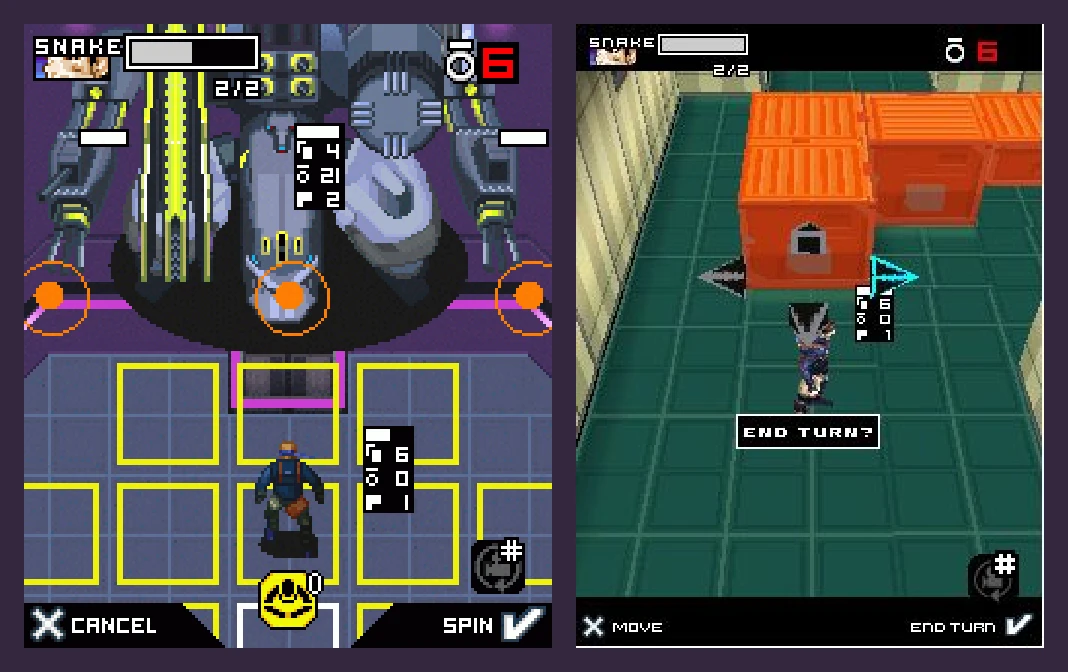
Plenty of people who owned a PSP never found out their phone could run Metal Gear Acid too. The card-battle Metal Gear was a launch title for the PSP, and a Java ME version for mobile phones was released by Glu Mobile in 2008 titled Metal Gear Acid Mobile. The sequel got the same treatment as Metal Gear Acid 2 Mobile.
God of War went further. God of War: Betrayal came out on June 20, 2007, made by Javaground and Sony Online Entertainment's Los Angeles studio. It was the first God of War on a non-PlayStation platform, and it is still the only one that never came out on any PlayStation.
Assassin's Creed had one too. Gameloft's version came out at the same time as the original back in 2007, a side-scrolling platformer that runs through the main plot points with the free-running and the hidden blade intact. From 2007 to 2012, every Assassin's Creed got a mobile version made by Gameloft. Konami even made a brand new Castlevania for Java phones, Order of Shadows, released in September 2007.
The pixel art version
Where the PSP got the 3D game, your phone usually got a hand-drawn one. God of War: Betrayal turned the series' 3D look into a 2D side-scroller, with character art and animation by WayForward Technologies and 110 different animations in all.
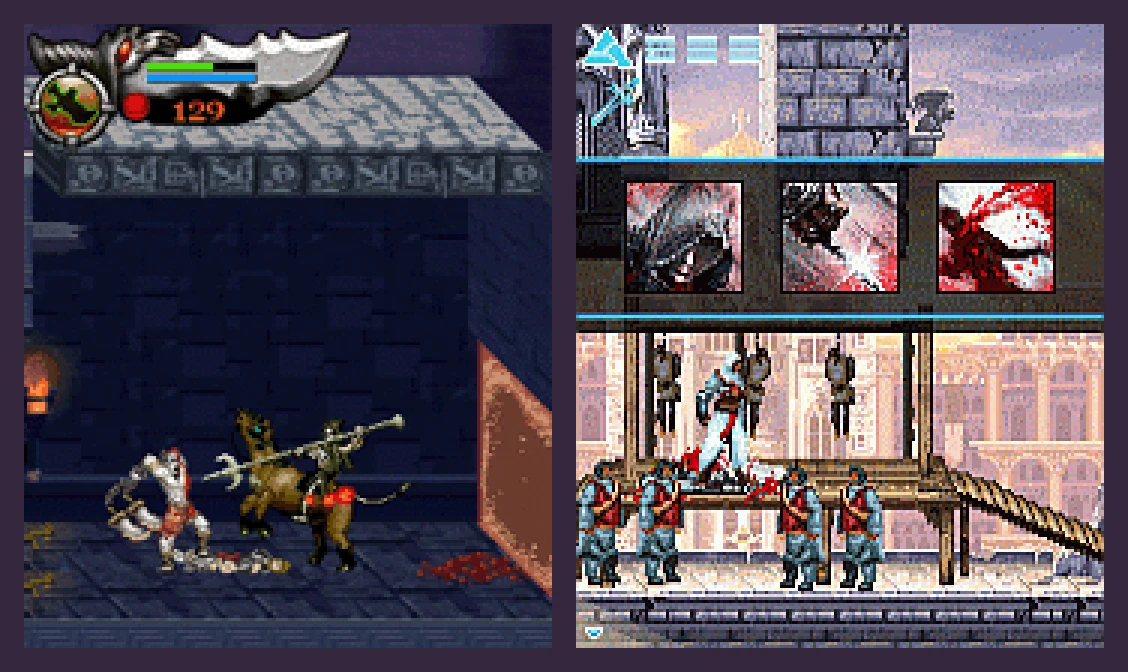
Ironically, some of it is among the best pixel art ever made. That is our opinion, not a measurement: if you think the Game Boy Advance looked good, the Java games looked even better.
One game, a pile of versions
Write once, run anywhere was the promise. The phones had other ideas. Think of how many different Android phones there are today. Java phones had the same problem, on far weaker hardware. Screen resolutions ranged from 101×80 pixels up to 640×320, with a dozen sizes in between, and high-end handsets had up to 90 times the processing power of the feeblest ones. Games almost exclusively used bitmap graphics, which have a fixed size and resolution, so a new screen size meant new art.
Metal Gear Acid Mobile shows how far it went. There were two versions of the game, a 2D version called Metal Gear Acid Mobile and a 3D version called Metal Gear Acid Mobile 3D. On top of that came the different resolutions to target.
The 25,000 builds Glu reportedly needed for its Transformers game became an industry legend, repeated with disbelief. One mobile developer said its own games normally ran to between 30 and 60 builds per language. It was a mess for a lot of developers, but it was so beautiful to see.
Ringtones, frogs and phone bills
Games shared the phone with another craze: ringtones. Jamba!, a German company sold to VeriSign, marketed its ringtones as Jamster in many countries and turned a cartoon called Crazy Frog into a monster. The Crazy Frog song went to number one in the UK charts, beating Coldplay.
Its TV ads became some of the most complained-about of 2005. They drew 298 complaints, many from parents angry that the ads did not make clear the ringtones were a subscription rather than a one-off download, and 24 complainants said their children had run up large phone bills. The UK's advertising watchdog banned the ads until after 9pm.
The taco phone

The biggest problem with Java games was simple: phones were not made to be consoles. Nokia then tried to make a phone that was also a real game console. The N-Gage came out on 7 October 2003, and the design did not help. To change games, you had to turn the phone off, take the back cover off and pull out the battery, because the game slot sat next to it. Then you held down the power button and waited for the system to boot up again. The speaker and microphone were on the side edge, so making a call meant holding the phone sideways against your face, which earned it the nickname "taco phone."
In its first weeks in the United States, the Game Boy Advance outsold it 100 to 1, and within 17 days retailers GameStop and Electronics Boutique were offering $100 rebates. The redesigned QD finally let you swap games without removing the battery, through a slot moved to the bottom of the device. Nokia discontinued the N-Gage on 26 November 2005 after selling 3 million.
Other phone makers came at it from the side. Sony Ericsson's W910 and W760 had dedicated gaming buttons above the display, so you could hold the phone sideways like a handheld, and its F305 from November 2008 was especially designed for gamers, with dedicated gaming keys next to the screen. Nokia's own N81 had two dedicated gaming buttons for N-Gage games, after Nokia gave up on the N-Gage hardware and moved its games onto selected Series 60 smartphones.
None of it stuck. Our read: nobody committed to the format, not even Nokia. The N-Gage was still a phone-ish console, and the gaming phones were still phones first.
Hunting for jars
There was an underground side too. Java games came as .jar files, and people hunted jar files and added the games to their phones themselves. Many of those games still run today, because the J2ME Loader emulator is compatible with most J2ME games.
The keitai games Japan can't get back
In the West, we have a lot of jars. Japan is a different story. Thousands of games were released for i-mode and the rival Japanese phone services, and many never left the country. Square Enix's Before Crisis: Final Fantasy VII was never released in the west, officially because western phones were too low-spec to run it.
Those games are much harder to save, and preservationists have spelled out why. Paid games will not play without the active SIM card used to buy them. An i-mode game could only be moved to a memory card with the phone's UIM card inside, the Japanese version of a SIM, and on the card it was locked with C2, the successor to DVD-Video's copy protection. A lot of games on au's EZweb service check their licence online, and most of them run on Qualcomm's BREW, native code that is harder to reverse-engineer than Java.
The phones fight back too. Phones on au spread their data over several flash memory chips, in stark contrast to Western Qualcomm-based phones, and there is a lack of chip datasheets for the hundreds of feature phone models. Then the shops closed. The i-mode website that hosted the last storefronts shut down in November 2021, and before it went the Game Preservation Society of Japan managed to download 876 titles, out of around 3,000 by one count. Before Crisis ended in 2018, when Square Enix shut down its old mobile services, and i-mode itself ended on 31 March 2026.
So for a lot of these games, the only copy left may sit on a phone that downloaded it years ago, and it only plays with the SIM that paid for it. Nobody has a full count of what is gone. Preservationists say the total number of Japanese phone games goes well into the thousands, and by spring 2025 the community had saved over 800 of them.
The day the deck closed
The App Store opened on July 10, 2008, and the little Java game started its long fade. Feature phones were overtaken by smartphones, and the platform that had put games on billions of phones went quiet.
Snake never really left, though. In 2017 Gameloft, the same company that had shrunk Prince of Persia onto a keypad, made the new Snake that came preinstalled on the Nokia 3310 (2017). The new one is fine. The jar you hunted down for a phone that could barely run it was better. You had to be there.