Nintendo sold 32.93 million N64s, and the library is small: 388 games were officially released, 85 of them only in Japan. Third parties mostly went to the PlayStation, so Nintendo leaned on its own franchises and on its second-party studios.
For a collector that is good news. A full set is a realistic goal on the N64 in a way it never is on the PlayStation, and most of the games people actually want to play were printed in huge numbers.
Most carts have no battery to die
Before you worry about dead saves, know the save types. Majora's Mask and both Pokémon Stadium games save to flash, so there is no battery to find. Ocarina of Time, F-Zero X, Super Smash Bros. and 1080° Snowboarding save to memory with a CR2032 cell soldered to the board, and when that cell dies the save vanishes.
Flash and EEPROM typically hold their data for over 100 years without power, while battery-backed memory has a far shorter life. So test the save on the battery games before you pay, and don't worry about the rest.
The Controller Pak has its own battery

The Controller Pak is the console's memory card, and it plugs into the bottom of the controller. Few first-party games use it, and the vast majority of games that do are from third parties. Mario Kart 64 keeps its ghost data there, and a fair number of games, Turok and Rayman 2 among them, save nowhere else.
The Pak has a CR2032 of its own, so a lost save can be a battery story even when the cartridge has no cell at all. If you collect third-party games, budget for a Pak that holds a save, and test it before you trust it with one.
Buy an Expansion Pak with the console

The Expansion Pak adds 4 MB of memory, doubling the system's total. Some games require it, including Donkey Kong 64 and The Legend of Zelda: Majora's Mask. Others lock content without it: Perfect Dark's single-player campaign needs it, and the box says only about 35% of the game is available without one.
The console won't boot without either the Expansion Pak or the small Jumper Pak that came in its place, so check which one a used console has. If you are buying your first system, setting a few dollars aside for an official Expansion Pak is the advice that saves the most frustration later.
Check the analog stick on every controller
The N64 controller's stick is the part that wears out. Controllers with tight, responsive sticks are worth significantly more than ones with the loose, wobbly sticks that are so common on heavily used N64 pads.
The console is built for multiplayer, too, so plan on more than one. A drawer of four tired controllers is a worse buy than two good ones, and you only find out which you have by holding them.
Cartridges are region-locked by their shape
Unlike the NES and SNES, the N64 looks the same everywhere. It enforced region locking through the cartridges themselves instead: each market's carts have different notches on the back, so a cart from one region won't go into a console from another.
So buy the console from the region whose games you want, and treat Japanese carts as a separate shelf. Remember the 85 Japan-only games when you do, because those need a Japanese console.
The Funtastic colours are where console prices climb
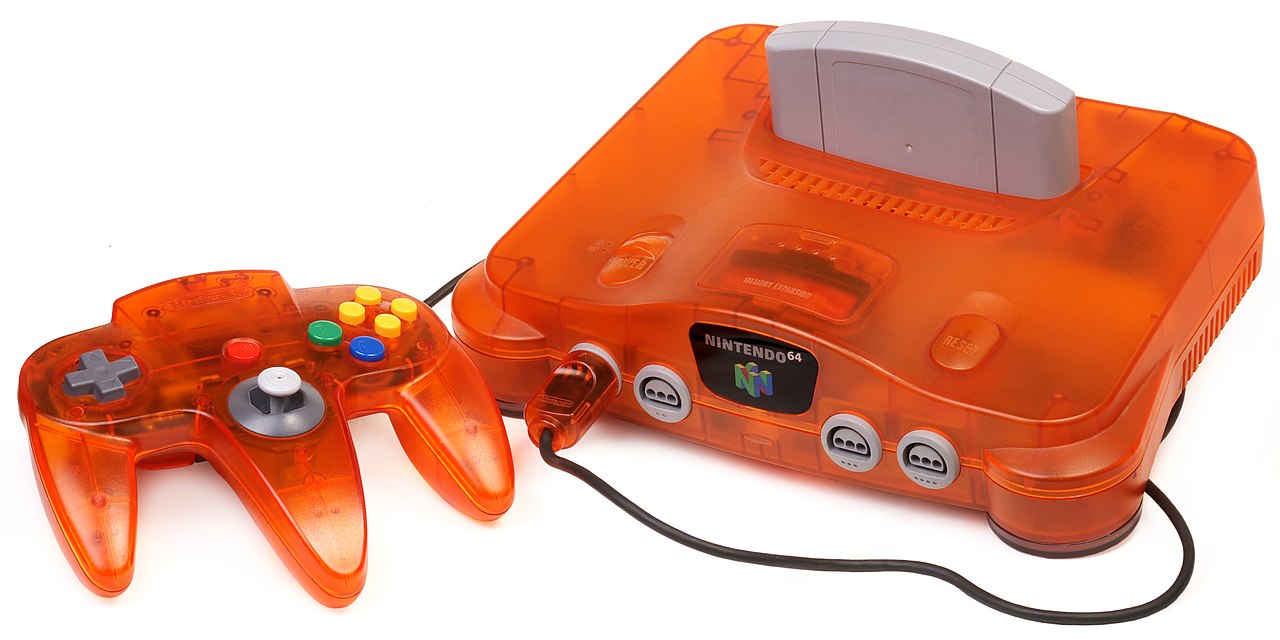
The standard N64 is charcoal grey, and a loose one sold for a typical $80 in June 2026. In the late nineties Nintendo also released six translucent colours, the Funtastic series: Ice Blue, Grape Purple, Jungle Green, Fire Orange, Smoke Black and Watermelon Red. In one dealer's guide from March 2026 they sold for $120 to $200 loose depending on the colour.
Jungle Green is the most common of the six, since it was bundled with Donkey Kong 64, and Smoke Black and Watermelon Red bring higher prices. The Pikachu edition, blue and yellow with a Pikachu figure on top, light-up cheeks and a Poké Ball power button, is one of the most desirable variants of all.
The big games are cheap
The famous games were printed in huge numbers and cost little loose. GoldenEye 007 sold for a typical $28 in September 2026, Donkey Kong 64 for a typical $34 and Super Mario 64 for a typical $39 that month. Mario Kart 64 went for a typical $43 and The Legend of Zelda: Ocarina of Time for a typical $50.
Boxed copies cost about three to four times as much. A boxed Super Mario 64 sold for a typical $145 and a boxed Ocarina of Time for a typical $175 in late summer 2026. Cardboard boxes simply didn't survive in the numbers the carts did.
The late games are the expensive shelf
Nintendo released the GameCube on September 14, 2001, and N64 games that came out in its last year or two cost more. Conker's Bad Fur Day, released in North America on March 5, 2001, sold well below expectations because of limited advertising and its release towards the end of the N64's life. Loose copies went for a typical $169 in May 2026.

Paper Mario sold for a typical $90 loose in spring 2026, and Super Bowling, a basic bowling game released in January 2001 when the system was already near the finish line, went for a typical $650 loose in the first half of 2026. That is a lot of money for bowling (the pins were never the expensive part).
One rental-only game sits above them all. ClayFighter: Sculptor's Cut was a Blockbuster Video exclusive, made only for rental stock, and only 15,000 to 20,000 copies were produced. When Blockbuster sold off its inventory in 1999, the carts entered circulation and stayed obscure, which is why it still commands four-figure prices.
Clean the slot with alcohol, not your breath
Cleaning the cartridge slot fixes most of the problems with the N64. Blow along the slot with an air duster, then rub a cotton swab moistened with rubbing alcohol along its length. Do the same to the contacts of any cart that won't start before you decide it is dead.
So a console sold as not reading games is often a cleaning job, not a repair. Price it as a gamble anyway, but a cheap one.
Reproductions copy the games you want
The most commonly faked N64 games include Bomberman 64: The Second Attack, ClayFighter: Sculptor's Cut, Conker's Bad Fur Day and GoldenEye 007, along with the Mario Party games and Super Smash Bros. One title is simple: The Legend of Zelda: Master Quest was never released on the N64, so every copy is a counterfeit.
Genuine labels were printed at high quality with a gold Nintendo seal, which often comes out dark brown on fakes, and fake labels tend to be glossy with slightly rolled edges. Authentic carts often have embossed batch codes on the back label, and a "brand new" listing for a long out-of-print N64 game is nearly always reproduction stock.