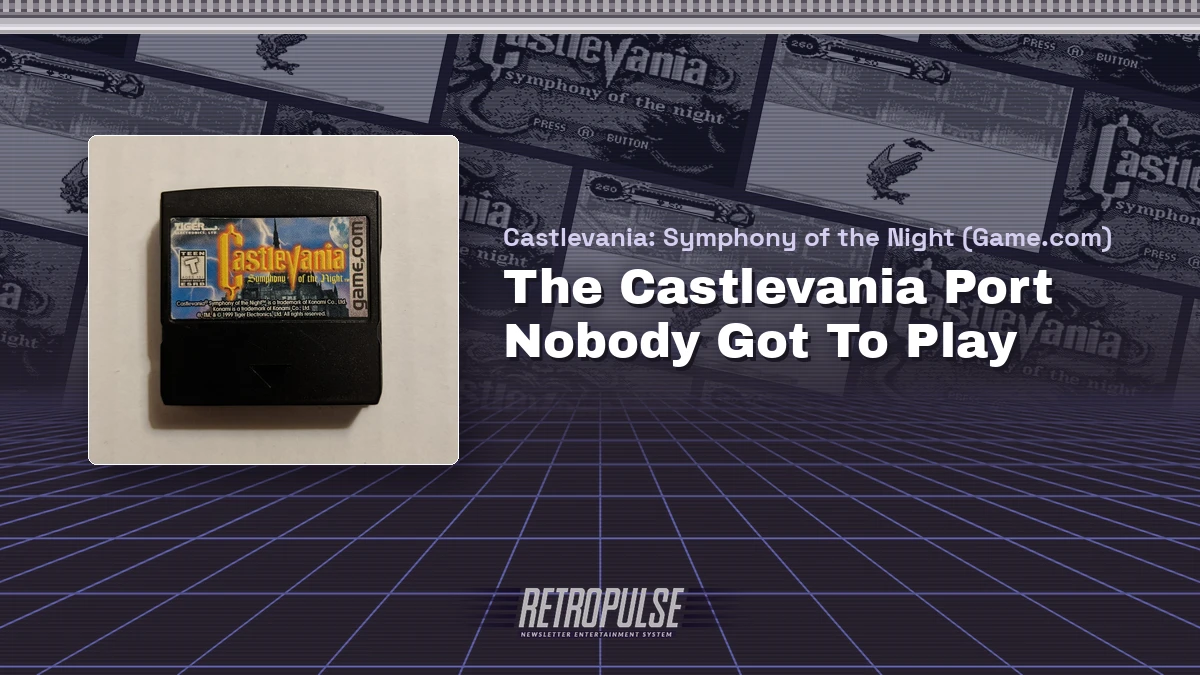
Tiger Electronics announced Castlevania: Symphony of the Night as an upcoming Game.com title. It was promoted in catalogs and on the blister pack inserts of the Game.com Pocket Pro, and Tiger even posted a few official screenshots online. Then the game never came out, and for years that seemed to be the whole story.
Many people believed the port never got further than a few mocked-up screenshots. However, a real cartridge with an authentic printed label turned up in 2019, and once it was repaired and played, it held a prototype that gets you through a surprising amount of Dracula's castle on a tiny gray screen.

A sleeper hit meets a doomed handheld
Symphony of the Night was released in Japan on March 20, 1997, and in North America on October 3, 1997. Konami Computer Entertainment Tokyo made it as a direct sequel to Castlevania: Rondo of Blood, starring Dracula's dhampir son Alucard, and it brought back the exploring and role-playing ideas the series had first tried in Castlevania II: Simon's Quest. It sold poorly at first. Even so, it grew by word of mouth into a sleeper hit, with 703,166 units sold in the United States and Japan.
Tiger, on the other hand, was a company known for hundreds of LCD handheld toys. It released the Game.com in the US in September 1997, at $69.95, aiming at older players than the Game Boy crowd. The library stayed small, limited to about 20 titles, and it was built around famous licenses such as Resident Evil 2 and Mortal Kombat Trilogy. The handheld sold fewer than 300,000 units before Tiger dropped it in early 2000. (A rough life, although at least nobody asked it to fight a vampire. Oh wait.)
So Symphony of the Night joined a short list of big ports Tiger never completed, next to a Game.com Metal Gear Solid. The prototype's build date is 1999, which puts it in the handheld's final stretch.
The dead cartridge that came back
Brandon Cobb, president of Super Fighter Team and the man behind a Game.com fan site, received the cartridge in 2019. He loaded it into his Game.com, and it did nothing at all. (Very on brand for the hardware.) In 2022 he sent it to Osman Celimli, who repaired the board inside, and by September Cobb was playing it through emulation.
In October 2022, the Diskman Presents channel posted a first look, played on a Game.com Pocket Pro. Then, on October 31, 2022, the prototype was released to download as part of a Halloween release, with thanks to an anonymous donor. The game sits on a flash cartridge.
Cobb did not oversell it. Still, he admitted that the game is "fairly well along", and the more you look at it, the more that stands out. Somebody at Tiger squeezed most of Konami's castle onto this machine, and that work survived.
Alucard in black, white and gray
The Game.com screen runs at 200 x 160 and shows black and white with 4 variations of gray. As a result, the port has been altered considerably from the original PlayStation game to fit the colorless, lower-resolution Game.com screen. On the original model, the screen also blurred, much like the Game Boy's, which does no favors to a game full of fast bats and dark corridors.

That explains Cobb's complaint about "hideous visibility". On this screen the castle's gothic halls become gray blocks with a small gray man walking through them. (Alucard has never looked more like a fax.)

Michiru Yamane through one mono speaker
The PlayStation music was composed by Michiru Yamane, and her score mixes classical and techno with gothic rock and jazz. The Game.com, meanwhile, puts out 8-bit mono audio from a single speaker in the upper left of the handheld. The port also lacks voice acting and has much lower-fidelity background music.
Cobb summed up the result in one line: "Laughable music, hideous visibility, and bargain basement gameplay." That is harsh, but the music part is hard to argue with. (Somewhere, a pipe organ is filing a complaint.)
Richter talks, but the fight never comes
The opening survives in an odd form. Richter Belmont and Dracula still trade their famous lines with the original dialog, but the boss fight that follows does not happen. Instead, a short block of text describes the battle, and then you are Alucard and the game carries on as normal.
From there, the prototype holds more than you would expect. Most of the text has been implemented, and the game keeps both the castle and the reverse castle, the upside-down second half that made the original famous. Alucard can collect his Bat and Mist forms, though his Wolf form never made it in. He can also bring one of two familiars, the Bat or the Ghost. The Fire Bat relic, on the other hand, can only be obtained with a cheat device. (Even Tiger's castle has a locked drawer.)

How far you get depends on your patience. When Cobb first tried it, he was quickly overwhelmed by its broken controls, and his fix for the second session was a bottle of merlot. He got as far as Marble Gallery and then seemed stuck, while the notes released with the dump say it can be played start to finish. Why Tiger stopped is not known. Cobb only says the work ended when corporate gave it the axe.
Worth one evening for any Castlevania fan
Cobb closed his verdict with "It would not have been a system saver." He is right. Nobody should play this instead of the real thing. Still, it is a rare look at how a licensed handheld port of the late 1990s got made, and at how much of a PlayStation classic could fit on a gray LCD before the plug was pulled.
So it suits two kinds of players: Castlevania fans who want to see every strange branch of the series, and Game.com collectors who know the machine's library by heart. You can download the prototype and play it via emulation, and a Game.com driver is available in MESS. For the full game, Symphony of the Night can be played on the PS1, Sega Saturn, Xbox 360, PSP, PS4, and Android and iOS devices.