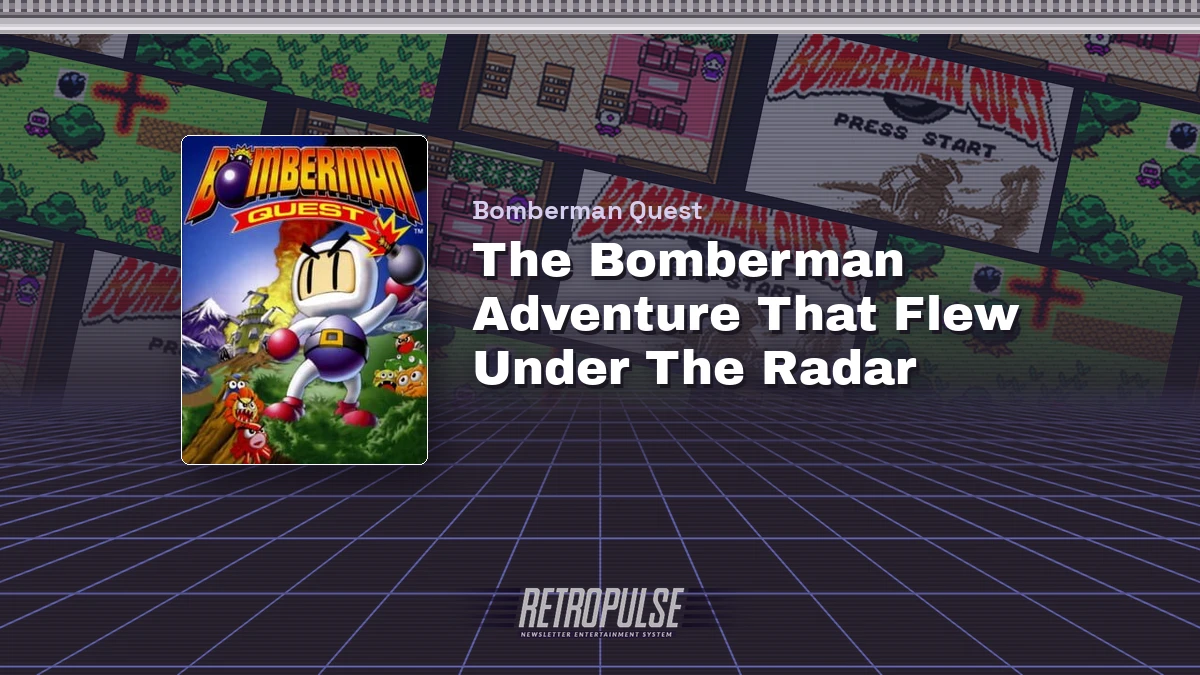
Bomberman Quest begins with a delivery gone wrong. Bomberman is flying a shuttle full of monsters he defeated in earlier adventures back to Planet Bomber when four Commanders ambush him, steal all four engines and send the ship crashing into a town called Peace Town. Naturally, every monster on board escapes. The spot where the shuttle came down, the game notes, used to be someone's field.
It was also a first. Hudson created Bomberman back in 1980, yet this 1998 cartridge was the first action RPG in the series, and it was built so that it runs on both the Game Boy Color and the original Game Boy. Some of its bosses, meanwhile, are guest stars from a Saturn fighting game that never left Japan.

Hudson's first Bomberman RPG
The work went to Eleven, the studio that had just made Saturn Bomberman Fight!!, which explains those guest stars. Director Shigeki Fujiwara had been on the series since the 1990 PC Engine Bomberman, and the producer had made Saturn Bomberman, so the team knew the character well before sending him exploring. Hudson released it in Japan on December 24, 1998, while Electro Brain brought it to North America in November 1999 and Virgin Interactive handled Europe.
In the West it slipped by quietly, however. When readers suggested games for a list of the best undiscovered Game Boy and Game Boy Color titles, it was among the names they offered. Even so, it left a mark on the series. Exploration worked for Bomberman again in Bomberman Generation, and when Super Bomberman R2 tried the same idea decades later, it was judged to lack the surprises and incentives that made this one a success. It also sits alongside Gargoyle's Quest as one of the Game Boy action adventures often considered classics.
Every bomb is a different tool
The key idea is that a bomb is a tool. Some explode in a cross, the classic Bomberman shape, and can stun an enemy if you throw them; others burst in a circle and can reach monsters flying above you. The Aqua Bomb only goes off underwater and refuses to explode on land at all, so the game keeps asking which one fits the job.
Monsters are puzzles as well. The first time you meet a new one, the game stops for a short conversation, and sometimes that chat hides a hint about how to beat it. Some can only be defeated with a particular item, so you won't always win the first meeting, and if you leave the screen before finishing a monster off, it heals back to full health. You can also pick monsters up and throw them, which works better than you'd think.
Peace Town and four zones
Peace Town is the hub, and from there the map branches into the Field, Forest, Beach and Desert zones, though at first only the Field Zone lets you in. Each one has its own character. The forest is crowded with trees and ledges that turn it into a maze, the beach hides monsters that leap out of the water, and the desert is nothing but sand and cactus.

The character designs come from Shoji Mizuno, who was in charge of art for the whole Bomberman series. Some of them also wink at other Hudson products: a monster called Jel looks a lot like a character from Teku Teku Angel, Hudson's walking pedometer toy. It's the kind of reference only a Hudson employee could love, which is presumably who put it there.
Jun Chikuma's farewell battle theme
The soundtrack came from several composers, among them Keiji Ueno, who had scored Chō Genjin on the Super Famicom, and Goro Takahashi, who had written for the Game Boy Sokoban in 1989. The most important name, though, is Jun Chikuma, the series veteran, who wrote the battle theme. Bomberman Quest marks the departure of Chikuma, which makes that battle theme one of his last pieces for Bomberman.
Four Commanders and nine bomb bases
The goal is to catch every escaped monster and take the engines back from the Commanders. Beating the Commander in each zone returns one engine and opens the next area, and every Commander you defeat raises Bomberman's maximum HP by one. The Water Commander, the only woman in the group, puts out your bombs with water, which is a rude thing to do to a man whose entire personality is bombs.

Back in town, a synthesis shop combines a bomb base with ingredients to make new bombs, such as Ice and Poison varieties, but you only find nine bomb bases in the whole game, so every choice counts. An old man collecting trading cards hands over a radio-controlled bomb, which you steer with the D-pad, if you bring him all three cards, and an ocarina lets you warp back to Peace Town as often as you like. Meanwhile, hidden bosses wait for anyone thorough enough: Mami and Lewysia, both guests from Saturn Bomberman Fight!!, turn up only after you have cleared the right Commanders, and the fighting game's final boss, Deral, shows up as well.
A battle mode that remembers your adventure
The two-player battle mode connects the two halves. You fight a friend over the Game Link Cable using the weapons and gear you found in the main game, so whoever has explored more starts with an edge. Your record changes your look as well. Win enough and Bomberman climbs to Bomb Emperor in silver armor, where a single loss knocks him back down, while a bad losing streak turns him into a version with a caterpillar body. (Character development, of a sort.)
Reviewers were warm rather than wild about it, with Famitsu giving it 23 out of 40 and GameSpot a 7.7. Players have been kinder: they often describe it as Bomberman played like a Zelda game, and it still makes our list of the best Game Boy Color games. One player summed it up as "a fun little romp", which is about right. The cartridge plays on both the Game Boy and the Game Boy Color, so any original handheld will do.