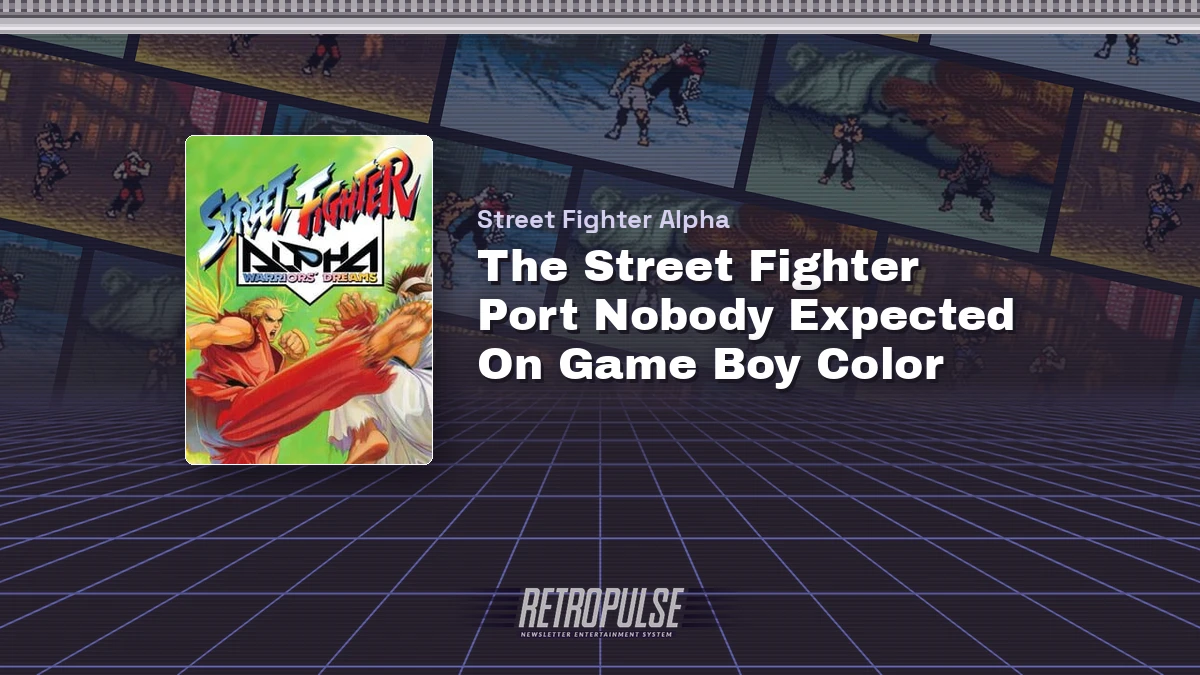
Street Fighter Alpha reached the Game Boy Color in Europe on December 17, 1999, and North America got it on March 24, 2000. Japan waited until March 30, 2001, and even there the cartridge kept the Alpha name instead of Zero, the name the series goes by at home. (Showing up a year late to your own party under a foreign name is a power move I respect.)
Capcom didn't do the conversion itself. Crawfish Interactive handled it, a studio founded in March 1997 that specialised in Game Boy Color and Game Boy Advance games. Shrinking a CP System II arcade fighter onto Nintendo's little handheld sounds like a dare, yet the port came out far better than it had any right to.

A runner-up in a strong year
The game got noticed at the time. GameSpot named it runner-up for both Best Game Boy Color Game and Best Fighting Game, losing the first to Dragon Warrior I & II and the second to Capcom vs. SNK: Millennium Fight 2000. Losing to a full-size crossover is no shame, however. (Second place behind two giants still counts as a trophy in my house.)
It also set up the studio's next job. Crawfish went on to port Street Fighter Alpha 3 to the Game Boy Advance, a version that earned a reputation as the system's best fighter, before the company closed in November 2002. Meanwhile, the Game Boy Color original kept a quiet following. Players still drop it into their lists of Game Boy Color games worth playing, right next to Metal Gear Solid and Link's Awakening.
Smooth animation that makes the fights work
The reason to care is the animation. The fighters don't show much in the way of facial expressions, but each one has a surprising number of frames, and that smoothness carries straight into how the game plays. There is none of the jerky motion that hurt the Game Boy version of Street Fighter II.
As a result, the fights feel smooth and accurate, and your favorite combos come out without a struggle. That was the verdict back then, too: the port was held up as the best fighting game on Nintendo's original Game Boy hardware and serious competition for the fighters Neo Geo Pocket owners loved.
On top of that, the screen scrolls vertically, something the Neo Geo Pocket's fighting games never did. It's a small touch, but it makes the screen feel bigger than it is. (The screen is not bigger than it is. I checked.)
Real proportions on arcade backgrounds
Crawfish also resisted the obvious shortcut. Instead of going super-deformed like SNK vs. Capcom: The Match of the Millennium on the Neo Geo Pocket, the sprites try to recreate the arcade originals, which keeps the Street Fighter purists happy. The game is nice and colorful, too, making good use of the Game Boy Color's palette.

The backgrounds are the pleasant surprise. They copy the arcade stages well, and some of them even move, which gives an otherwise limited handheld some depth. Small touches like that turn up throughout the game.
Still, none of this came free. Both the graphics and the sound were downscaled to fit the cartridge, so the arcade's music reaches you as a pocket-sized version of itself. (Like hearing your favorite song through a wall. You still know every word.)
The arcade rules, minus a second player
The arcade game behind it revamped the Super Combo system with a three-level gauge that fills as you attack, and after blocking a hit you can spend a level on an Alpha Counter. It also brought in Chain Combos and the ability to guard in mid-air, and its roster added Charlie Nash and Rose as new faces next to Ryu and Ken.
The handheld version has one big gap. It has no link cable support and is single-player only, which is a strange fit for a series built on beating your friends. (Your friends were spared. Your little brother was not, because he had to watch.)

The controls split opinion, too. Plenty of moves come out cleanly, but the bigger inputs ask a lot of a small handheld, and one player admitted they "can't even pull one of them for Charlie on the GBC port", talking about his super moves.
Worth it for the animation
Street Fighter Alpha on the Game Boy Color is a cut-down game. The sound is smaller and there is no versus mode over a cable. On top of that, some supers fight you harder than your opponent does. Next to the arcade original, it comes up short in every way you would expect.
Even so, it moves like a real Street Fighter game, and that was the hard part. When Capcom gathered the series on PS2 in Street Fighter Alpha Anthology, it used the arcade releases, so the Game Boy Color version stayed on its own cartridge. If you love ambitious arcade ports on hardware that had no business running them, play it on a Game Boy Color and enjoy how far Crawfish pushed it.