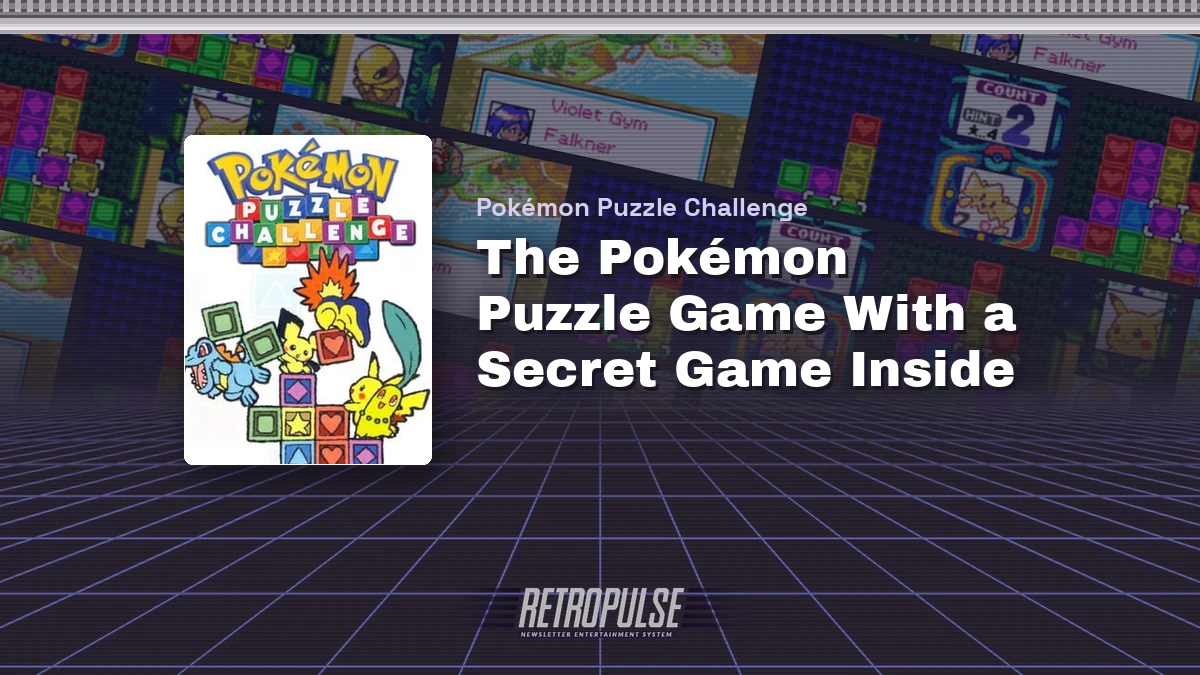
Pokémon Puzzle Challenge carries a whole other game in its code. Buried inside the cartridge is a nearly finished game of Panel de Pon, the Japanese puzzle game behind the whole series, and you reach it with a button code at the warning screen that normally tells original Game Boy owners this is a Game Boy Color-only cartridge. So the message that turns you away is also the secret door.
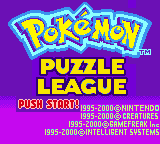
It went through a few names before release, too. Nintendo first announced it in January 2000 as Pokémon Attack, after Tetris Attack, then briefly called it Pokémon Puzzle League like its Nintendo 64 cousin, and an unused title screen with that name is still in the game. Even its release date was shuffled: Nintendo planned to push it into 2001 until the delay of Kirby Tilt 'n' Tumble opened a slot.
Puzzle League goes pocket-sized
Intelligent Systems developed it and Nintendo released it in Japan on September 21, 2000, in North America on December 4 and in PAL regions the following June. It was the second Pokémon game in the Puzzle League series, and where the Nintendo 64 Pokémon Puzzle League followed the anime, this one draws on Pokémon Gold and Silver instead.
Critics loved it. It holds a 90.20% average on GameRankings, which made it the 10th best-rated Game Boy Color game there, and Nintendo Power gave it a perfect score before later naming it the 13th best Game Boy game ever. Game Informer placed it 12th on its own list, crediting extra polish for putting it ahead of Tetris Attack. Even so, it ended up on a list of the best undiscovered Game Boy and Game Boy Color games, a strange fate for something that scored that well. It finally came back in 2014 on the 3DS Virtual Console.
Swap two blocks, start a chain
The rules are pure Puzzle League. You move a two-block cursor that swaps blocks side by side, and lining up three or more of the same color clears them while new rows push up from the bottom. Clearing more than three at once makes a combo, and when falling blocks set off another clear you get a chain, which is where the game gets its hooks into you.
In competitive modes, combos and chains drop garbage blocks onto your opponent's grid, so the best defense is a long chain. The small screen forced some compromises. The grid is only six blocks wide and nine tall, compared with twelve rows in the other games, and you can't see your opponent's grid at all; a small meter shows how close they are to losing instead. Even so, one critic called it as fun and addictive as it ever was, and Nintendo Power rated it second only to Tetris for addictiveness.
Johto on the Game Boy Color
Everything around the blocks belongs to Gold and Silver. Challenge mode sends you across the Johto region to face trainers and gym leaders, the music is remixed from those games, and your side of the screen is decorated by a Pokémon partner. You start with Chikorita, Cyndaquil or Totodile and unlock six more by meeting goals in Challenge mode and beating their trainers, while four extra Pokémon hatch from eggs once you post high scores in the other modes.

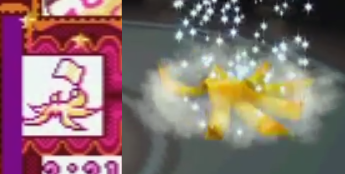
The colorful visuals still get singled out, and the little losing animations have personality. Jynx's, for example, is just her detached hair waving a white flag, a callback to beating her in Pokémon Stadium.
Gold and Silver tunes, remixed
The soundtrack takes its songs from Gold and Silver and rearranges them for the puzzle field, and the mix of music and sound effects was praised for being unusually good for the system. One player, fresh from beating Pokémon Crystal, said they "especially love all the music".
Six modes and two hidden difficulties
There are six main modes. Marathon runs until the grid fills, Challenge is the Johto tour, Time Zone is a score attack against the clock, and Line Clear asks you to clear a set number of lines per stage. Puzzle hands you fixed layouts to solve in a limited number of moves, while Garbage is Marathon with extra garbage blocks dropping in. There's a training mode too, and with a Game Link Cable two players can play versus, Time Zone or Line Clear.

Hard isn't the ceiling, either. On Challenge mode's difficulty screen, press Select and A while Hard is highlighted to unlock Super Hard, then do it again on Super Hard to reach Intense, the toughest setting in the game. (Nothing says relaxing puzzle game like a mode called Intense.) Its one notable gap is the Puzzle Edit mode from the Nintendo 64 game, which reviewers missed.
Still the best pocket Puzzle League
Pokémon Puzzle Challenge doesn't reinvent Tetris Attack, and it doesn't need to. A colorized portable version was enough, as one critic put it, and it holds up because the core is so strong. Players still reach for it for quick sessions on handhelds, often calling it one of their favorite puzzle games, and you don't need to care about Pokémon to enjoy it. The original cartridge needs a Game Boy Color or later, and if you still own a 3DS with the Virtual Console version, that works too.