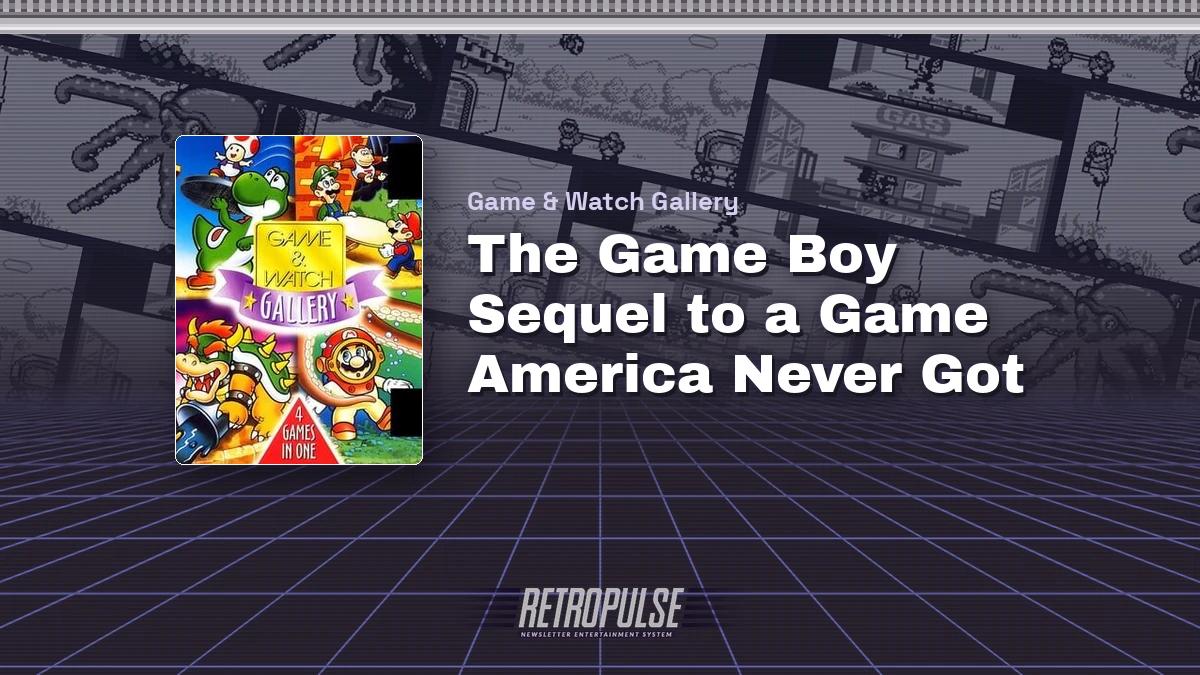
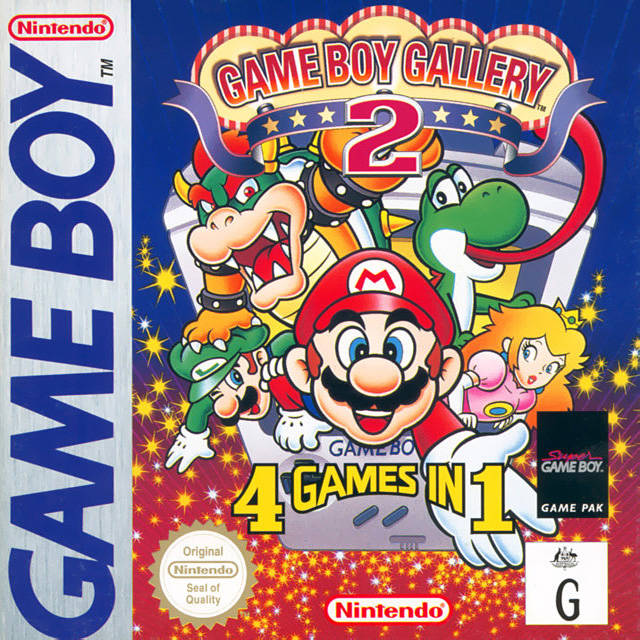
Game & Watch Gallery looks like the start of a series, but it is actually the second entry. It follows Game Boy Gallery, a 1995 collection that only came out in Europe and Australia, which is why Australian shops sold this one as Game Boy Gallery 2. Japan, meanwhile, simply called it Game Boy Gallery, so the same cartridge carries three different names depending on where you bought it.
What it holds is a little museum. Gunpei Yokoi's Game & Watch handhelds paired a single game with a clock on a segmented LCD screen, like the ones in calculators, and this cartridge brings back four of them, first released between 1980 and 1982, each in two versions. Score well enough and it even unlocks animations of other Game & Watch games you never get to play.
A remaster before the word caught on
Tose developed it and Nintendo published it in 1997, with Nintendo R&D1 sharing the design work. It reached Japan on February 1, the United States in May and Europe on August 28, and it turned into a run of Galleries. Three more followed, ending with Game & Watch Gallery 4 on the Game Boy Advance in 2002.
Its bigger legacy is the idea itself. James Newman's book Best Before cites it as an early example of the remastering trend that took over during the PlayStation 3 and Xbox 360 era, because it dresses up the visuals while keeping the original gameplay. In other words, Nintendo was selling you your old games with a fresh coat of paint years before everyone else made it a business model. Japan got it again in 2000 through the Nintendo Power cartridge service, and the 3DS Virtual Console brought it back in 2011.
Four LCD classics, each played twice
Every game comes in two forms. Classic mode copies the original gameplay and the look of the old LCD screen, while Modern mode adds new mechanics, better graphics and music, and characters from the Mario games. Both have Normal and Hard settings, so there is more here than four games would suggest.
That split is the whole appeal. Classic mode is a faithful history lesson, but Modern mode is where the games actually change, and some of the changes are clever. Critics were mostly positive: one called it a strong "twitch" game and compared it favorably to Tetris and Dr. Mario, and IGN's readers later voted it the best Game Boy action game of the century. Another reviewer called every game on the cart "a simple yet dangerously addictive dose of pure unfettered and unvarnished fun", which is a lot of adjectives for catching people falling out of a building.
Mario moves into the LCD screens
The Classic versions keep the visuals of the original hardware, so every figure jumps between fixed positions like a calculator with ambitions. Modern mode, by contrast, redraws everything with Mario and his friends, so Mario dives for treasure under the octopus and Yoshi lays manholes in the street.


Color is limited, however. On a Super Game Boy or a Game Boy Color the games get a modest color upgrade, which helps, though nobody will mistake it for a Game Boy Color game. The music comes from Yoko Mizuta and Jin Sugita, and Modern mode is where they get to show off, since its enhanced music gives the remixed games real tunes to go with the new faces.
Two buckets in Oil Panic, a head start in Manhole
In Fire, you hold a tarp to catch people jumping from a burning building and bounce them to safety; in the Modern version, different characters stay in the air for different lengths of time, which throws off your rhythm. Manhole asks you to plug gaps in the street so pedestrians don't fall through, and the Modern version mixes walking speeds while letting Yoshi set a manhole cover in advance that only drops when someone steps on it.

Octopus has you grabbing treasure from a sunken chest while dodging the tentacles, and in Modern mode the more treasure Mario carries, the slower he gets. Greed has consequences, even underwater. Oil Panic, finally, is about catching falling oil and dumping it without hitting bystanders or letting the bucket overflow, and its Modern version hands Mario two buckets at once that he can swap around.
The long game is the star chart. Every 200 points in a game earns a star, up to five in each mode and difficulty, for 80 stars in total. Those stars unlock entries in a gallery of animations from other Game & Watch titles, which is a tidy way to make you replay Oil Panic one more time.
Built for a few minutes at a time
Not everyone was charmed. One reviewer argued that without nostalgia for the originals it is "little more than a curiosity", and another liked the updated versions but found the originals less engaging and wished the cartridge held more games. Both complaints are fair, since four games is a slim package even with two versions of each.
Still, players keep coming back to the Game & Watch Gallery games for the same reason: you can pick one up for a few minutes and put it down again without losing anything. That is exactly what it was built for. The original cartridge runs on any Game Boy, and if you have a Super Game Boy or a Game Boy Color, you even get the color upgrade.