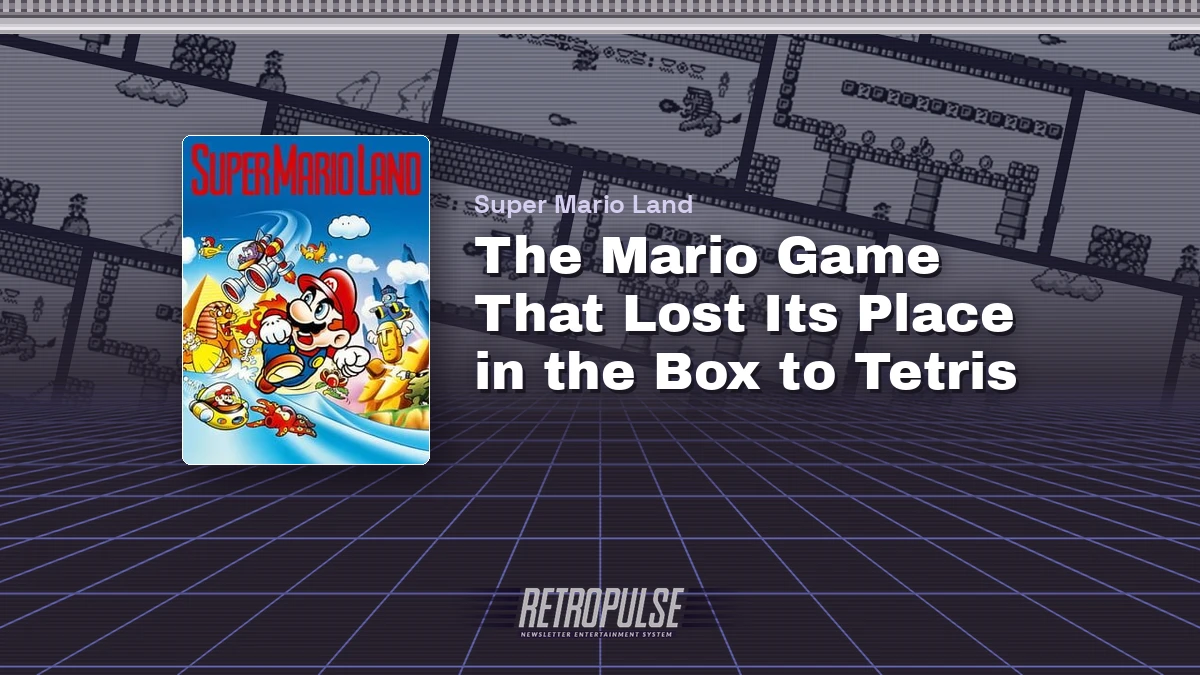
Super Mario Land was supposed to come in the box. Nintendo planned it as the Game Boy's pack-in game, the showcase that would sell the new handheld, until Henk Rogers, who held the rights to Tetris, convinced Nintendo of America that Tetris would reach a bigger audience. So Tetris went into every box, and Mario launched alongside it as one of the system's four launch titles.
It was also the first mainline Mario game made without Shigeru Miyamoto. Gunpei Yokoi, the Game Boy's creator and once Miyamoto's mentor on Donkey Kong, produced it, and Satoru Okada directed, the same pair behind Metroid and Kid Icarus. Without Miyamoto's direction, the team shrank the series to fit a tiny screen and added ideas that never quite belonged to Mario before or after.
Twenty-five million copies and a new princess
Losing the pack-in slot didn't hurt it much. Super Mario Land came out in Japan on April 21, 1989, and in North America that summer, and it went on to sell more than 25 million copies, the fourth best-selling game on the Game Boy. In North America it was the second best-selling release of 1989, behind only the bundled Tetris, and it even outsold Super Mario Bros. 3.
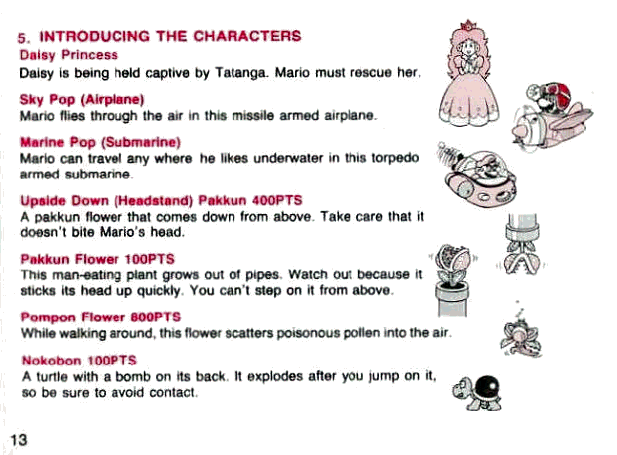
Its legacy is bigger than its size. It introduced Princess Daisy, who went on to appear in Mario's sports and racing games, and it began a series: Super Mario Land 2: 6 Golden Coins introduced Wario, and Wario Land: Super Mario Land 3 turned him into the star of his own games. Its theme music even became a UK top-ten novelty hit, when Ambassadors of Funk built the house track Supermarioland around Hirokazu Tanaka's tunes.
Mario Bros., shrunk and bent
At heart, it's the original Super Mario Bros. adapted to a small screen. You run right through 12 levels, split into four worlds of three, to rescue Princess Daisy from Tatanga, an evil spaceman, in the land of Sarasaland. The screen only scrolls forward, so anything that slides off the left edge is gone for good.
Two of those levels aren't platforming at all. Instead, Mario pilots a submarine or an airplane through Gradius-style shooting stages, firing at enemies, blocks and bosses as the screen pushes forward. Meanwhile, each regular level ends with a choice of exits; the higher, harder one leads to a lottery bonus game that pays out extra lives or a Superball Flower. Finish the game and a harder mode with more enemies opens up, and beating that lets you start from any level.
Line art and a tiny Mario
Everything is drawn in simple line art, and Mario himself is just 12 pixels tall. Critics at the time loved having a portable Mario, with one calling it "an arcade machine in your pocket", but some Famitsu reviewers found the graphics blurry and less appealing than the Famicom games. One later critic worried about eyestrain on a screen that small.

The enemies are the strangest part. Instead of the Mushroom Kingdom regulars you get sphinxes, seahorses and Moai heads, alongside oddities like the Honen, which the manual says are the skeletons of Torion eaten by Tatanga. Even the Koopas aren't quite Koopas: they're Bombshell Koopas whose shells explode after you stomp them, because the team didn't have time to recreate the classic shell ricochet on the Game Boy. (A turtle that explodes when you stomp it is a turtle with boundaries.)
Hirokazu Tanaka's earworm
The soundtrack is the part nobody argues about. Hirokazu Tanaka wrote it, and critics have called it "surely one of the all-time greats". It's bright and catchy enough that a house producer heard house tempos in it. There are smaller touches too, such as the bonus game music, which sounds a lot like the hurry-up theme from Clu Clu Land.
Superballs, hearts and a different-feeling Mario
Mario plays differently here. He feels lighter, with more friction, and his fire power-up is replaced by Superballs, black balls that bounce around the screen. Extra lives come as hearts instead of mushrooms, and the flagpole at the end of each level gives way to that two-exit choice. A few familiar pieces remain, from floating blocks and pipes to Goombas and the 100-coin extra life.

There are five bosses, one at the end of each world and then Tatanga himself. You can skip the first three by running past them to the exit, but the last level has no regular exit, so its two bosses have to be destroyed. It's all over quickly, too: one review noted it can be finished in under an hour.
Short, strange and worth an hour
Super Mario Land is the oddball of the series, and some critics have said it hasn't aged as well as other Mario games. Even so, it took real risks, and one reviewer called it "radical and distinctive" for exactly that reason. Players still recommend it as a short game that's a lot of fun. It's easy to find, too, with a 3DS Virtual Console release in 2011 and a place in the Game Boy library in Nintendo Classics since May 15, 2024.