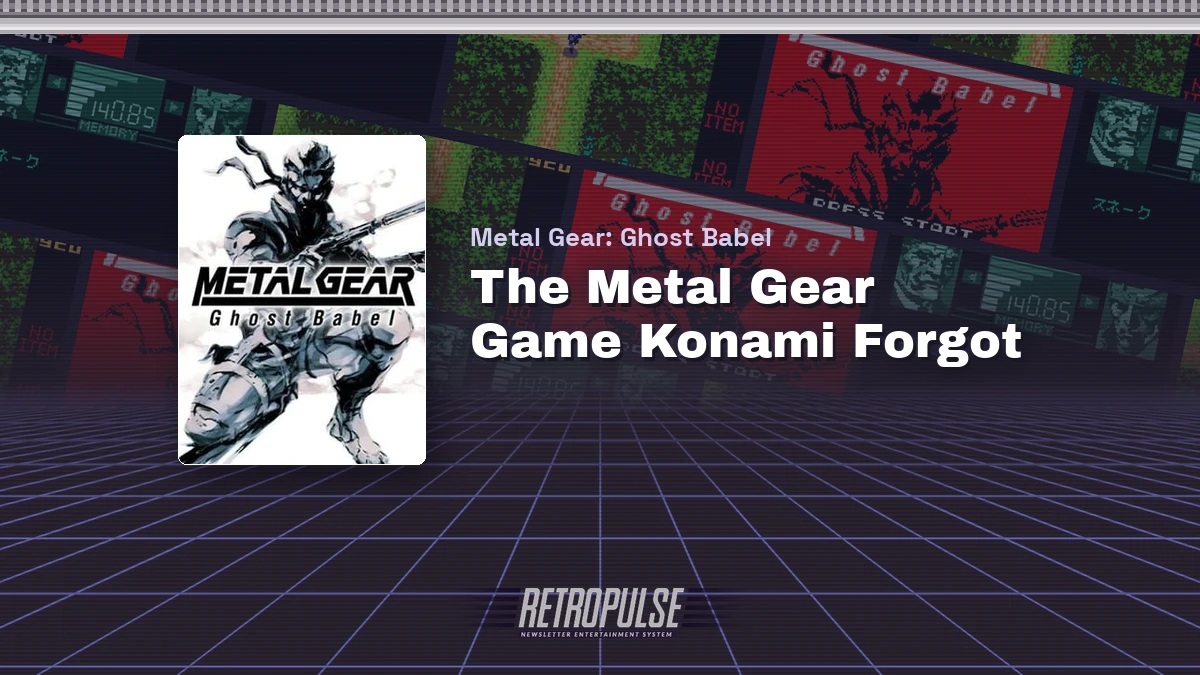
Metal Gear: Ghost Babel exists because Konami's European office wanted more Metal Gear after the PlayStation hit and asked for a portable one. Konami Computer Entertainment Japan took the job with help from TOSE, the prolific ghost developers from Kyoto, and the game reached the Game Boy Color in 2000. Outside Japan it was sold as plain Metal Gear Solid, even though it tells a brand new story. (Naming your handheld game after a different, more famous game is a bold choice. I respect the chaos.)
The American cartridge is also missing a piece. A hidden radio drama called IdeaSpy 2.5 sits behind codec frequency 140.07 on a second playthrough, and Europe got it in English thanks to a bigger 32mb cart. The North American cart was smaller, so the drama was cut to save space.
A side story that starts where the MSX2 game ended
The plot branches off from the end of the original Metal Gear on the MSX2. Gindra, a fictional African nation, is in the middle of a civil war, and a militant group called the Gindra Liberation Force has stolen a Metal Gear prototype codenamed Gander to turn the tide. As usual, Colonel Campbell calls Solid Snake out of retirement, this time to infiltrate their headquarters in Galuade, which was originally called Outer Heaven. Chris Jenner, the lone survivor of an assault team that failed to recover the mech, joins him in roughly the role Meryl played on the PlayStation.
The bosses go by Black Chamber, and they include a pyromaniac with a flamethrower backpack and a former serial killer who travels with two dressed-up puppets. Somehow the game still earned an E for Everyone rating in North America. Snake did have to put the cigarettes away, though, so he reveals laser trip wires with a "Fogger" instead. (Quitting smoking in the middle of a hostage crisis. The man is a machine.)
The story is not considered canon, yet it left marks on the series anyway. At the end, the Colonel mentions that the mission was a training sim for someone named Jack, which is Raiden's real name in MGS2, and Snake's Five-seveN pistol later shows up among the many weapons of MGS4. The Snake and Campbell portraits replaced the old celebrity lookalikes in the updated Metal Gear 2 released on mobile phones and in Metal Gear Solid 3: Subsistence. Even the engine got a second life: the Game Boy Color version of Perfect Dark is built around it.
The PlayStation toolbox on a Game Boy
Instead of shrinking the PlayStation game down, the team built a new scenario and made it every bit as full featured, while keeping the look of the 8-bit originals. Every button on the Game Boy Color has a job, some of them odd ones. Start makes Snake crouch, while Select pauses the game, and that pause screen is where you swap gear and call up the CODEC.
Snake can now aim in eight directions, up from the four of his earlier outings. He can also slide along walls and knock on them to pull a guard over, both new to the 2D games. Most of the weapons return, minus the sniper rifle and the Stinger missiles, and the Soliton radar made the trip as well. It has shrunk and lost the guards' cones of vision, but it works remarkably well. Meanwhile, Mei Ling is back to save your game and offer words of support. (Proverbs at the save point, like a fortune cookie that also does your filing.)
As a result, the cartridge feels bigger than the MSX2 and NES games. Its 13 stages are more linear, however they are expansive and flip to a new screen far less often, so the camera can scroll around and show you what lies ahead, which the 8-bit games never managed. The stages mix things up, too, with a floor of electrified puddles here and a run of conveyor belts there.

Shinkawa's cast on a tiny screen
It looks like the MSX2 games, as you would expect, within the limits of the Game Boy Color. Ikuya Nakamura, who worked on art and design for the PlayStation game, came back as graphics designer and adapted Yoji Shinkawa's character designs to the much smaller format. Some of the tricks only show up in motion. In the sewers, the rushing water comes from alternating sprites, an effect no screenshot can capture. It also turns up on lists of the Game Boy games that pushed the hardware, praised for its fluid animation and well-built mechanics.
The soundtrack came from Norihiko Hibino, a Berklee College of Music graduate, and it was the first of many times he would write music for the series. The hidden radio drama was a debut, too. IdeaSpy 2.5 was Shuyo Murata's first credit in Metal Gear, and he went on to contribute to Metal Gear Solid 3 and Peace Walker. His story follows a secret spy called 2.5, employed by the FBI to stop the J.E. (Junker Expensive) Corporation from selling busted products in New York City, with one episode in each of the 13 stages. Hideo Kojima later had it adapted for his Japanese podcast, HIDECHAN! Radio, in 2006, with the director himself in the lead role. (Naturally.)
The second lap is where it shows off
Finish the game once and a stage select opens up, with three new challenges added to each stage. Some ask you to speed run a stage or get through without taking damage. Others get stranger: one fills a stage with ghosts who need sending on to the next world, and another straps a bomb to Snake that goes off if he stands still for more than a second. (Snake is the bus from Speed now. Keanu would be proud.)
Replaying stages adds story as well. You play a nameless agent, strongly hinted to be another of the series' heroes, who lives through Snake's mission in VR while the mysterious No. 4 fills in the new details. VR Missions come back too, with some levels redone from the PlayStation version and many others original.
On top of that, there is a competitive multiplayer mode over the Game Link Cable, a first for the series. Two players chase drones for the data disks that unlock the goal, and the first one there wins. Much like the guards, you only see your rival when they step into your cone of vision.

Where the ambition bites
It does have rough edges. Hitboxes around Snake feel inconsistent: sometimes a soldier whiffs a hit right beside him, and other times one clocks him from several pixels away. The large stages can be confusing to navigate, since plenty of areas lack clear landmarks, and more than a few fans admit they started the game and never reached the end. Then there is the hardware. On a real Game Boy Color, with its tiny unlit screen, that clever Soliton radar turns into an eye strain. (My optometrist thanks you for the business.)
Worth hunting down the cartridge
Ghost Babel's ambition pays off. It feels wonderful to play, and its story holds up against the best in the series. Players agree. It is the number one game on our list of the best Game Boy Color games, and the people who go back to it keep calling it great. One player went further: "Ghost Babel is the Metal Gear game I've replayed the most."
Playing it today takes some effort. It has never been re-released in any form, so the original cartridge is the way in, and it never got a large print run, which makes it one of the rarest regular Metal Gear releases. Watch out for the knock-offs and fakes that plague the retro market. Konami has mostly forgotten it, but if you love Metal Gear, it belongs next to the big ones.