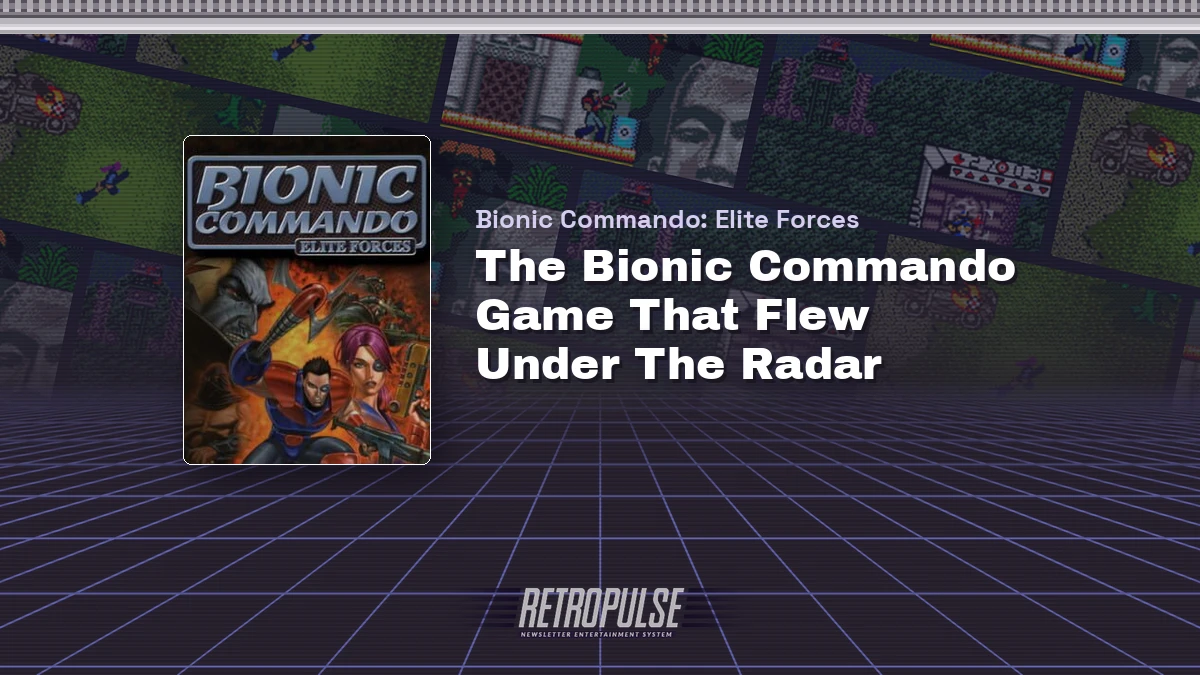
Bionic Commando: Elite Forces was supposedly released on December 31, 1999, in the final hour before Y2K was going to end civilization, although the copyright screen insists on 2000. (I choose to believe it shipped as the clocks rolled over, mostly out of spite.) Despite the name on the box, it isn't a Capcom production at all. Nintendo published it, and its American studio NST built an entirely new game rather than converting another company's code.
The studio's fingerprints are all over the cartridge, too. Buried in its files are graphics from NST's Game Boy Color remake of Crystalis, which didn't come out until five months later. Somebody was clearly working on two games at once and never labeled their folders, and that person is my hero.

A quiet ending for the series
Elite Forces did the series no favors. It landed somewhat flat, and Bionic Commando then went quiet for nearly a decade before anyone tried again.
NST fared much better. The studio went on to Metroid Prime Hunters, along with the GBA Mario and Donkey Kong titles, so nobody should feel too bad for them.
It didn't reach many players in the first place, either. The initial release covered only North America and Australia, and these days the game turns up on a list of the best undiscovered Game Boy and Game Boy Color games, which is a polite way of saying almost nobody played it. Lately it has found a small audience on retro handhelds, where people play it and, occasionally, even finish it.
The arm still works
What still works is the arm. The swinging is actually more refined than in the NES Bionic Commando, and once you find the rhythm you can cross long stretches from platform to platform without touching the ground. That is the entire appeal of the series, and Elite Forces gets it right more often than not.
The progression helps, too. Your life meter starts short and grows as you defeat enemies, while each stage hands you another weapon or item, so the game picks up a faint Super Metroid and Castlevania: Symphony of the Night flavor as it goes. Calling it a Metroidvania would be a stretch (a big one, the kind I would pull a muscle doing), but building up your commando over time is genuinely satisfying.
Loud colors, well-animated sprites
The graphics are a harder sell. The palette was most likely picked to stand out on the Game Boy Color's screen, which had no backlight, but on its own terms the game looks very garish. Some areas come out bright and vivid while others turn dark and murky, and the scenery repeats itself, often giving you three areas in a row with the same look before moving on. Back on the NES, no two levels looked the same. The trip does cover forests, deserts, mountains and futuristic cities; it just takes the long way round.

The sprites are the saving grace. They carry more detail, as you would expect from a Game Boy Color exclusive, and they are animated quite well. (If you must be garish, at least move nicely. That is also my dating advice.)
Catchy songs on chirpy instruments
The soundtrack is a mixed bag. It is mostly original, with only one tune carried over from the 1992 Game Boy game, and some of the compositions are rather catchy. The trouble is the instruments, which are chirpy enough that the whole thing sounds like a first-generation Game Boy game, an odd result when the 1992 release sounded much better. The sound effects are rather muddled as well.
The digitized voice samples deserve a special mention, though not a kind one. They come out very crackly and indistinct, as if your commando is reporting in from the bottom of a well. Someone was very proud of them, and I am happy for that person.
Same war, new commando
The story is the usual business. The Avar army has laid siege to the land of Karinia, its leader Arturus has found the Albatross Project, and Commander Joe goes in to stop it and promptly fails. (Super Joe has apparently been demoted. Same, buddy.) So in comes the Bionic Commando to clean up, except this time it isn't Rad Spencer. You name the hero yourself and choose a man or a woman, and although the differences are mostly cosmetic, a couple of stages change depending on your pick.
From there you land on the familiar map screen, complete with the helicopter and the enemy trucks. Every stage square is now the same color, however, because the Neutral Zones are gone entirely. They never did much beyond holding key items, but the map feels emptier without them. Running into an enemy truck still drops you into an overhead scene, just like the NES game, except now you move left and right to reach the end instead of pushing straight ahead. Destroying the bigger enemy vehicles nets you a bonus life.

Comm rooms and cheap deaths
The comm rooms are where you contact home base or tap into the enemy frequency for inside information, and you can also swap weapons and decoders there and save your game. The tension of the old wire-taps is mostly missing, though. Only a few set stages answer your eavesdropping with an enemy assault, and even then all you get is a couple of standard soldiers.
Since the cartridge has a battery backup, continues are gone and you get lives instead, and you will need them. The levels aren't brutally hard, but they do frustrate. You can hold Up and Down to look above and below you, yet there's not much you can do to look ahead, so a swing into the unknown can end in a soldier's face. On a screen this small, some jumps become leaps of faith. At least you can drop from a ledge by pressing Down twice, which is a welcome addition. The controls themselves split opinion: some find them more solid than the 1992 game, while others find them not quite as tight.

Elsewhere, a few first-person sniper sections feel strangely out of place, though mercifully they're brief. Hidden comm rooms lead to secret levels that really test your skill with the arm, and the reward is just a new color for your commando and bragging rights. (Bragging to whom? The cat?)
Worth it for the swing
Elite Forces is a hard game to love wholeheartedly. It's garish, and too many of its deaths come cheaply. Next to the NES original, or even the 1992 Game Boy game, it comes up short.
Still, it is a full Bionic Commando adventure with more than 20 levels, and the swinging at its core is the real thing. Not everyone is so hard on it, either: one player called it "an incredible sequel to the NES classic". If you love the series and can forgive the colors, it's worth your time. It later got a second release on the 3DS Virtual Console, so bring low expectations for the voice acting and maybe sunglasses for the palette.