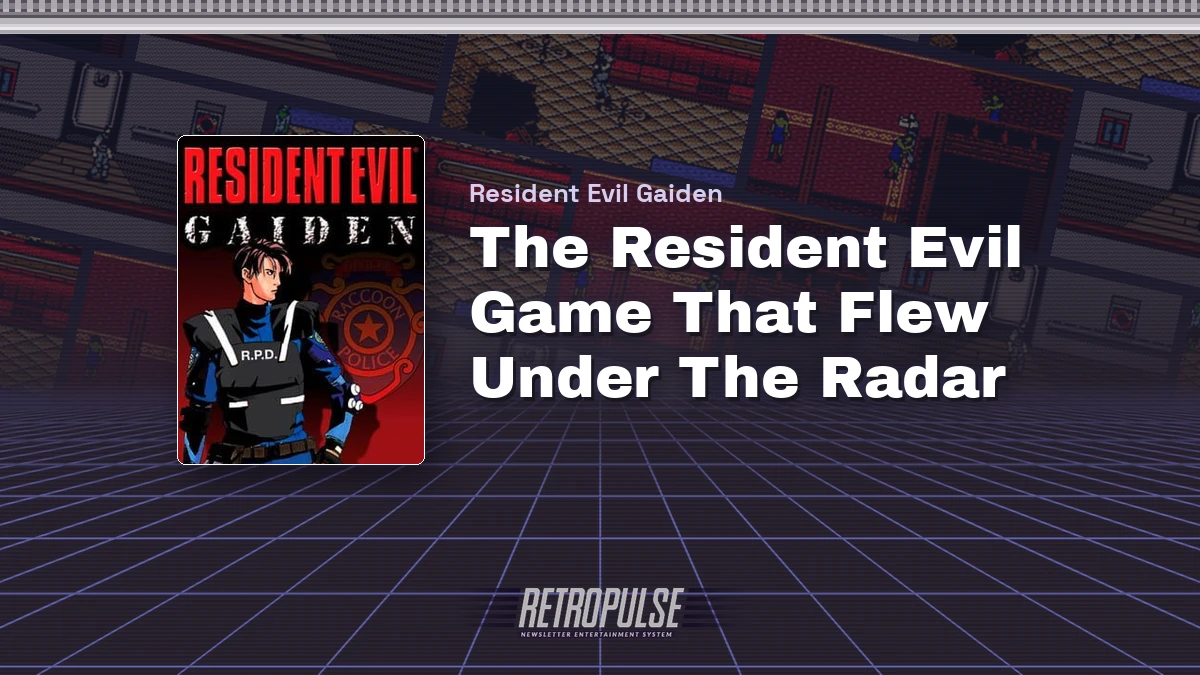
Resident Evil Gaiden started out as a dinosaur game. Capcom wanted a Game Boy Color demo of Dino Crisis, so its European publisher Virgin Interactive handed the job to M4, a small British studio. Capcom liked that demo enough to ask M4 for an original Resident Evil built on the same engine. (The producer says he still has backups of absolutely everything from M4, but he is in Brazil and the backups are in the UK. Somebody please go and get that box.)
The release was just as odd. Europe got the game first, on December 14, 2001, while Japan waited until March 29, 2002 and North America until June 4, 2002. By then the Game Boy Advance had been out for more than a year, and many fans of the series skipped this Game Boy Color release when it first appeared.

The handheld Resident Evil that made it out
Capcom badly wanted a handheld Resident Evil that worked. It had already run into trouble shrinking its home console games, first with Resident Evil 2 on the Game.com and then with an unfinished Resident Evil port for the Game Boy Color. Once Gaiden got the green light, Capcom dropped that port for good.
The story had a rougher ride. Gaiden was originally supposed to be canon and line up with Resident Evil Code: Veronica, and Wesker's Report even mentions Leon joining an anti-Umbrella organization. However, the ending implies that the Leon you see is a Bio Organic Weapon wearing his face, and Resident Evil 4 makes it clear that this is not the case. As a result, Capcom struck the game from the official timeline, and it is the only game in the series left out of the canon. (Leon has had worse weeks, though probably none that ended with him being written out of history.)
A cruise ship full of twists
The plot is the reason to care. Leon has joined an underground group fighting Umbrella, and his orders send him aboard the Starlight, a luxury ocean cruiser rumored to carry a new bio-organic weapon. Headquarters loses contact with him soon after he boards, so Barry Burton from the original Resident Evil goes in to find him. The crew and passengers are zombies by then, of course. Barry also meets Lucia, an orphan girl who can sense the new weapon, and her strange abilities make him wonder where she came from.
From there the story keeps turning. Hiroki Kato wrote an original plot and sent it to M4 without ever working with the team directly, and it is the part even the harshest reviews liked. GameSpot's Frank Provo applauded the clever storyline for its many twists and turns, while Retro Gamer later called it a "superb actioner with a gripping storyline" and "an underrated classic" on its list of the top ten Game Boy Color games. The monster can change its shape, and the last shot before the credits is about as mean as the series gets. (I won't spoil it. I will only say that I trust nobody now.)
Detailed rooms on a tiny screen
The graphics split people. On release, GamePro's Mike Major felt the visual presentation got in the way of the creepy atmosphere, and Computer and Video Games criticized the graphics too. Players have been kinder over the years, and they still count it among the best-looking games on the Game Boy Color.

It nearly looked better still. The Game Boy Advance launched in March 2001, and with everyone's attention on the new handheld, M4 pushed to move the game over and built a prototype with improved graphics. Capcom and Virgin kept it on the Game Boy Color anyway, citing the high cost of redrawing assets and reprogramming, plus the low margins on Game Boy cartridges. (Somewhere an accountant won an argument, and I hope they enjoyed it.) Even so, the finished game is a fascinating example of design built around hardware limits.
A score from Shahid Ahmad
Shahid Ahmad composed the music, and the soundtrack has its fans. One player summed it up as "a bangin soundtrack", which is the kind of review every composer secretly wants. Gaiden came out of a small team, too: Tim Hull designed it, and James Cox and Kieron Wheeler programmed it.
Top-down halls, first-person fights
Gaiden plays nothing like the PlayStation games. You explore the ship from a top-down view, collecting items and fighting what you find, with three playable characters over the course of the story. Walk up to an enemy, however, and the game switches to a first-person battle screen with a reticle sliding left and right. Press the action button while the reticle is over the enemy to hit it. Shinji Mikami stayed mostly hands-off as a content advisor, but the sliding reticle was his idea. The battle concept itself came from M4, inspired by the 1987 role-playing game Dungeon Master, and the staff believe it was a big reason Capcom hired them.

The critics were rough on the rest. IGN's Craig Harris gave it a 4.0 out of 10, calling the save system impractical for a handheld, since you can only save at limited save points. He also disliked the puzzles being reduced to collecting keys and items. Computer and Video Games disagreed on that point, finding the puzzles on par with the rest of the series and praising the battle system. The reviews averaged out at 56.46% on GameRankings, which is mixed in the most literal sense.

Players who finish it tend to defend it on survival horror grounds. Ammo is scarce, so wasting bullets on fights you could have walked around leaves you in trouble later. That tension is exactly what the PlayStation games were about, and plenty of players say Gaiden gets it right. (Conserving resources is also how I approach social plans. It works about as well.)
Worth playing for the story
Gaiden is easy to make fun of. It is non-canon and its saves are stingy. Still, the story holds up, and the game rewards you for playing it the way a Resident Evil should be played.
It is no longer cheap, however. One guide to the rarest Game Boy Color games priced it at $77 to $290, with a sealed copy at $340. Plenty of players run it on retro handhelds these days instead, and they keep finishing it. If you like the old Resident Evil games and can live with a reticle that never sits still, it is well worth the trip.