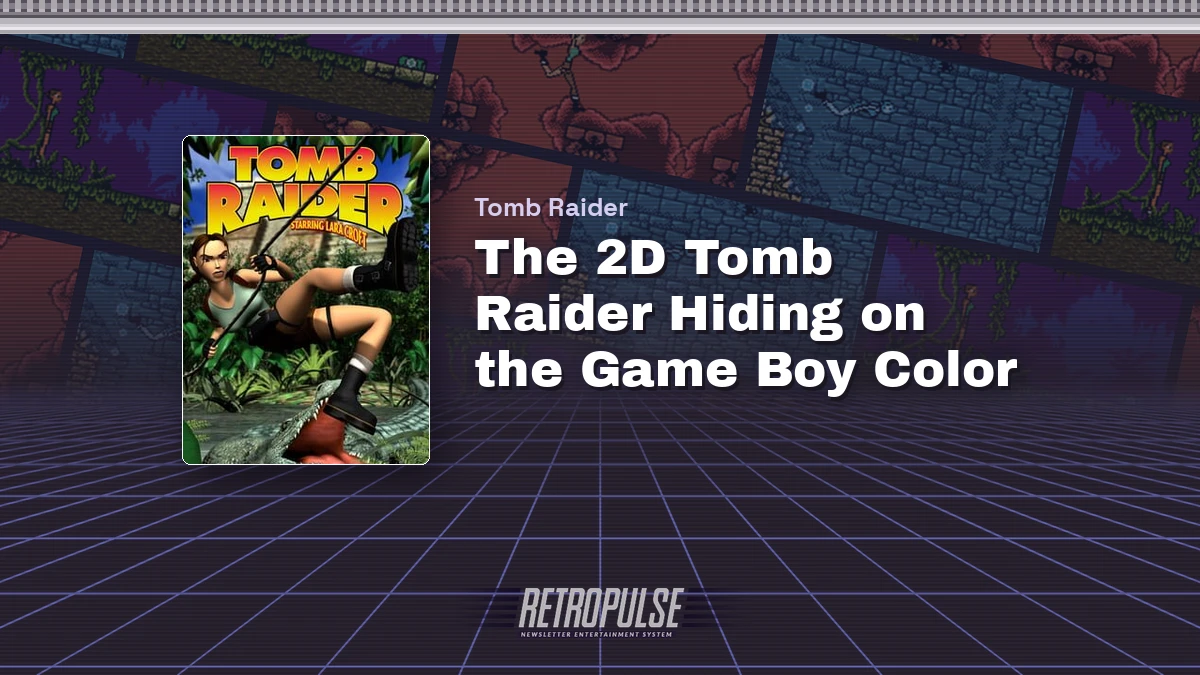
Lara Croft's first game on a Nintendo system wasn't a port of anything. Core Design, the studio that created her, rebuilt Tomb Raider as a 2D side-scroller for the Game Boy Color, and in 2000 it arrived as a handheld adventure of its own. In North America the title even added "Starring Lara Croft", in case anyone was unsure who the star was.
She also arrived in style. Lara's sprite is 48 pixels, far bigger than other heroes on the system, and behind her sit more than two thousand frames of animation rendered from the home console originals. Core Design was trying to fit the PlayStation's most famous archaeologist onto a Game Boy Color, and it very nearly pulled it off.

Lara's first trip to Nintendo hardware
Eidos owned the series, so it licensed the game to THQ, which had a large library of Game Boy Color titles; Core Design did the actual work. The game was announced in November 1999 and reached North America on June 7, 2000, then Europe later that month and Australia in July, where THQ reported that it sold out on release. It sold well for THQ, and two sequels followed: Curse of the Sword on the Game Boy Color in 2001 and The Prophecy on the Game Boy Advance in 2002.
Critics liked it too. It averages 79% on GameRankings, with IGN giving it 8 out of 10 and GameSpot an 8.1. Still, it remains one of the series' many spin-offs, a side road off the main games.
The PlayStation moveset, flattened
The surprise is how much of Lara survives the trip. She has up to 25 moves, including ledge grabs, backflips and cliff dives, and reviewers were impressed that so much fits on the Game Boy Color's handful of buttons. The game plays like the 3D originals seen from the side. Each of the 14 levels, spread across five areas, mixes puzzles and platforming with the odd fight against whatever lives in the ruins.
Each area also has its own idea. In the temples you spend a lot of time on ropes, while the caverns are mostly about swimming. The volcanic stages, meanwhile, have you dash-jumping over flowing lava. As a result, the game changes pace often enough that the 2D format never feels like a cut-down version of something bigger.
Two thousand frames of Lara
The graphics are the main event. Lara moves in surprisingly fluid motions, very close to the animations of the PlayStation original, and the backgrounds are packed with detail. To make all of that animation run, the team used direct memory access. Lead programmer Sean Dunlevy wrote the engine.

The cutscenes take a different route. Instead of animating them, the game uses pre-rendered still images, which gives it a slightly cinematic look between levels.
Shin'en's sampled sound
The audio came from Manfred Linzner and Bernhard Wodok of Shin'en, and Tomb Raider was among the company's first projects. Their approach is minimal. Sampled sound effects carry the mood while you explore and solve puzzles, which was unusual at the time, because most Game Boy games avoided or barely used the system's ability to play back samples.
That restraint suits a game about being alone in very old buildings that would prefer you left.

The Nightmare Stone and an evil god
The story keeps things simple. A group of treasure hunters wants the Nightmare Stone, a key that can release an evil god called Quaxet, and Lara sets out to stop them in ruins across South America. (Quaxet sounds like a cough medicine, but fine.) The plot is mostly there to give you a reason to visit the next temple.
The levels are where the time goes. Every stage asks you to find a route with the moves you have, so a lot of the challenge is reading the screen and deciding whether a ledge is within reach. Lara's size cuts both ways here, since a big sprite on a small screen leaves less room to see what's coming.
A side road worth taking
Overall, Tomb Raider on the Game Boy Color is a solid 2D adaptation, and at the time it showed how much the handheld could do with a famous character. It has the series' structure and Lara's athletics, scaled down without losing the point.
It also still surprises people who try it now. One player who missed it as a kid called it "surprisingly good", which is about the most accurate review it will ever get. It isn't part of Nintendo Classics, so the original cartridge is the way to play it, and since it's a Game Boy Color-only game, it needs a Game Boy Color or later.