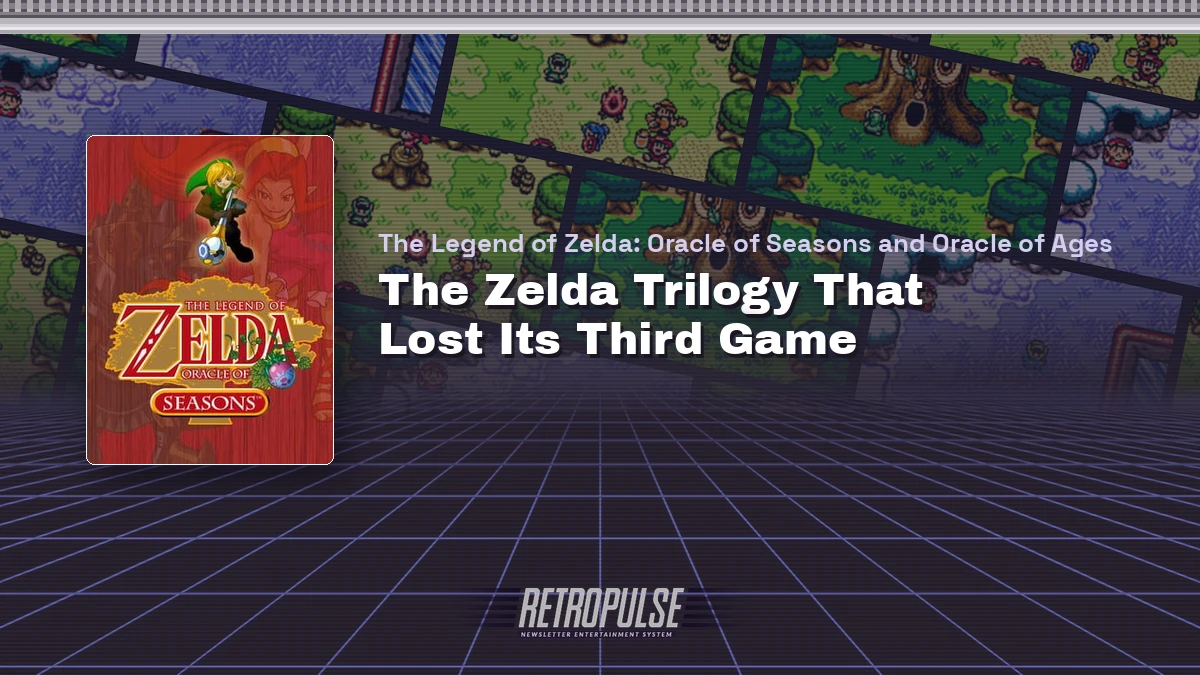
The Oracle games were meant to be three. Capcom's Flagship team planned a trilogy named after the pieces of the Triforce, Mystical Seed of Power, Wisdom and Courage, which you could play in any order, with each game changing the story of the others. Coordinating three games through passwords proved too complicated, so Shigeru Miyamoto suggested cutting it to two. Power became Oracle of Seasons and Wisdom became Oracle of Ages. Courage was canceled.
It began as something smaller still. In early 1999, Flagship's head Yoshiki Okamoto pitched Miyamoto a Game Boy Color remake of the original Legend of Zelda, partly so younger children could play it and partly as a test run for a bigger sequel. The remake kept changing until it had an entirely different world map, and the team that wanted an original Zelda from the start got its wish.
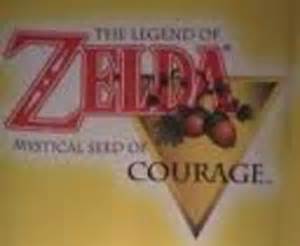
Capcom's Zelda, released as a pair
Flagship was Capcom's scenario-writing studio, and more than ten of its writers worked on the stories, among them Resident Evil writer Junichi Miyashita. Hidemaro Fujibayashi led the team as director and designer, while series artist Yusuke Nakano designed the characters, borrowing faces from Ocarina of Time for Seasons and from Majora's Mask for Ages. Both games came out together in Japan on February 27, 2001, and in North America on May 14, roughly a month before the Game Boy Advance.
Together they sold 3.99 million copies. Critics were delighted: GameSpot named them its best Game Boy Color game of the year, and Nintendo Power later placed them fourth and fifth among the best Game Boy and Game Boy Color games. Japan alone bought 746,054 copies, which made them the third best-selling Game Boy Color games there.
Two complete games that talk to each other
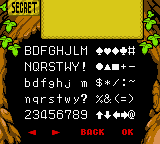
The trick is the link. Each game is a full adventure on its own, with the look and controls of Link's Awakening, but Ages leans toward puzzles while Seasons leans toward action. Finish either one and you get a password to start the other as a sequel, in which characters hand out secrets you can carry back to the first game for items and upgrades. Rings can be traded the same way or created by connecting two games with a link cable.
Only a linked game gives you the real ending. In the second adventure the plot expands, Twinrova kidnaps Princess Zelda to light the third Flame and revive Ganon, and you finally get to fight both of them; the true final bosses only appear there. Players still name these two among their favorite Zelda games, and the linked story is a big part of why.
Seasons that repaint the map
Critics loved how they look. Gaming Age called them "the pinnacle of good graphics on the Game Boy Color system", and Seasons has the extra trick of swapping its whole palette with the season, which made it the more impressive of the two for IGN. Stand on a stump, swing the Rod of Seasons, and winter freezes a lake you can walk across, while summer grows vines you can climb.

There's a hidden bonus for anyone who played on the newer handheld, too. On a Game Boy Advance, a secret Advance Shop appears where everything costs 100 rupees, and its owner is amazed you found the place. The 3DS Virtual Console versions don't have it.
Familiar themes on a tinny speaker
The music came from two composers at the sound company Pure Sound, credited only as M-Adachi and Kyopi. The selection was praised for mixing familiar Zelda songs and sounds, such as the classic puzzle-solved jingle, with new music. Even so, reviews of the audio were mixed. The Game Boy Color's speaker didn't help, and some sound effects were dismissed as simplistic beeps.
Rods, harps and a pile of rings
In Seasons, the Triforce sends Link to Holodrum, where Onox, the General of Darkness, kidnaps Din, the Oracle of Seasons, and throws the seasons into chaos. Link can't use the Rod at first; each of four towers adds another season. Holodrum is also linked by portals to Subrosia, an underground world of dwarf-like Subrosians. In Ages, Link lands in Labrynna, where Veran, the Sorceress of Shadows, possesses Nayru, the Oracle of Ages, and the Harp of Ages lets him travel between present and past. Either way, you collect eight Essences from eight dungeons before the final confrontation.

The item design pairs neatly across the two. The Seasons slingshot and the Ages seed shooter both fire seeds, and the magnetic gloves and switch hook both reach places you otherwise can't. Unusually for Zelda, even the sword and shield have to be assigned to one of your two item buttons. Around the edges, rings grant bonuses, a trading sequence ends with an upgraded sword, and the animal friend you choose changes the shape of some areas. (Everyone has a favorite animal friend, and everyone else is wrong.)
Still the best pair on the Game Boy Color
Oracle of Seasons and Oracle of Ages are two of the best games on the system and, played together, one of the most ambitious things Nintendo ever let another studio do with Zelda. They came to the 3DS Virtual Console in 2013 and joined the Game Boy library in Nintendo Classics in 2023, so the best way to play is to start one, note the password, and keep going into the other.