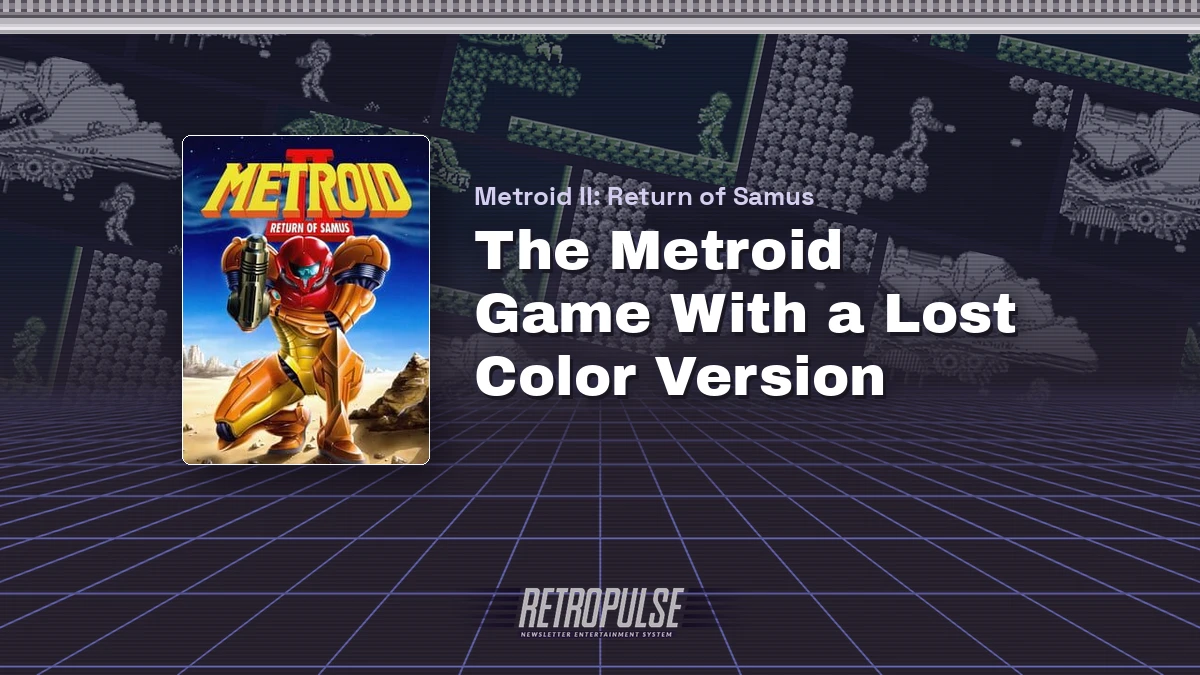
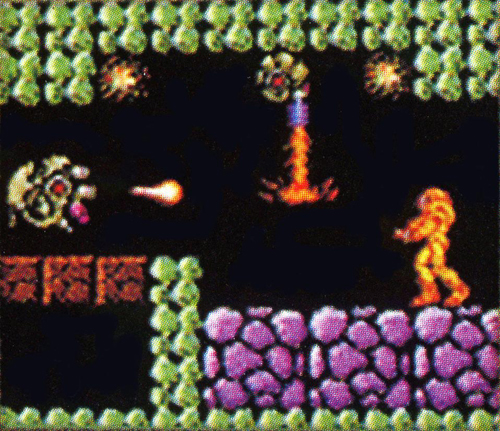
For a while, Metroid II was supposed to get a color makeover. A German magazine once printed a screenshot of "Metroid II: Return of Samus DX", a Game Boy Color version that would use the new handheld's far bigger palette, in the same spirit as Link's Awakening DX. It never came out. Some accounts say the release was canceled, while a Nintendo of America translator said he had never heard of such plans, so that screenshot may have been a mock-up all along.
The game that did come out has its own oddities. Its planet, SR388, was named after a Yamaha SR400 motorcycle, and because the Game Boy couldn't show Samus's Varia Suit as a different color, the designers gave it big round shoulders instead. Every Samus since has worn them.
The sequel that set up Super Metroid
Nintendo had a habit of making new games rather than ports for the Game Boy, and Metroid II, like Super Mario Land and Link's Awakening, is a full sequel. Nintendo R&D1 made it with Gunpei Yokoi producing, the same pairing behind the original, and it reached North America in November 1991, before Japan and Europe in 1992. By late 2003 it had sold 1.72 million copies.
Its influence runs through the series. It introduced the Space Jump, the Spazer beam and the Spider Ball, and it was the first appearance of Samus's ship. More importantly, its ending sets up Super Metroid: after the last battle, Samus finds a Metroid egg, and the hatchling imprints on her as its mother, so she spares it. Two remakes followed decades later, the fan-made AM2R in 2016, which Nintendo had taken down, and the official Metroid: Samus Returns on the 3DS in 2017.
Hunting every last Metroid
The premise is a hunt. The Galactic Federation's teams have vanished on SR388, the Metroids' home planet, so Samus goes down to wipe out the species, 47 of them. A counter on the screen shows how many are left, and once you clear an area, an earthquake drains the liquid that blocks the way deeper into the planet.
What makes it frightening is evolution. The Metroids from the first game turn out to be larvae, and the ones on SR388 have grown into Alpha, Gamma, Zeta and Omega forms, each larger and more dangerous. Often the only warning is an empty shell lying on the ground, which leaves you creeping forward until you find whatever crawled out of it, and running into the first one that has evolved into a form you aren't ready for is legitimately scary. Watching the counter tick down by one after each kill, meanwhile, becomes its own reward.
Bigger Samus, darker caves
Samus is much larger than on the NES, which makes her easy to see against the dark backgrounds but also makes the screen feel cramped. Without color, the caves blur together. The original Metroid had distinct areas in both design and color, whereas here it's mostly caves and more caves, and critics at the time were split on the graphics: some praised the sprites and animation, others found them plain or too dark.

Even so, for a handheld in 1991 it was striking, with graphics close to an NES game. The screen also scrolls freely in every direction now, instead of only sideways or up and down, which allows larger rooms and more elaborate layouts.
Harsh music by Ryoji Yoshitomi
Ryoji Yoshitomi wrote the music, and it's the most divisive part of the game. There are only a few pieces. The surface theme is catchy, but the rest is harsh and dissonant, and one critic called it downright painful. Still, it builds a tense atmosphere that works in the game's favor, provided your ears can take it.
Spider Ball, Space Jump and 150 missiles
Samus starts better equipped than before, with the Morph Ball and some missiles from the beginning, and she can now crouch while firing and shoot straight down mid-jump. The Spring Ball finally lets you jump in ball form, so no more bomb jumping, and the Spider Ball sticks you to walls and ceilings. The Space Jump, in turn, lets Samus jump again and again in mid-air, practically flying once you get the timing down.

The weapons are a mixed blessing. The Spazer fires three beams in a spread and the Plasma Beam passes through enemies, but you can only carry one beam at a time, and switching means walking back to where you found the other. Since evolved Metroids only take damage from missiles, hunting for missile tanks matters more than ever. There are save points and refill stations, though no automap, so it's easy to lose your bearings, and checking every wall and ceiling with the Spider Ball for secrets gets tedious. The final fight against the Queen Metroid needs around 150 missiles, unless you roll into her mouth and bomb her from the inside. (Respect to whoever first tried that.)
Still worth the trip down
Metroid II is harsh and repetitive in long sessions, and later games do almost everything better. Even so, it's remarkable that such a deep world fits on a tiny cartridge, and the dread of tunneling into SR388 hasn't faded. When we surveyed players about the best Game Boy games, it made the top ten. These days it's easy to play, too: it came to the 3DS Virtual Console in 2011 and to the Game Boy library in Nintendo Classics in February 2023.