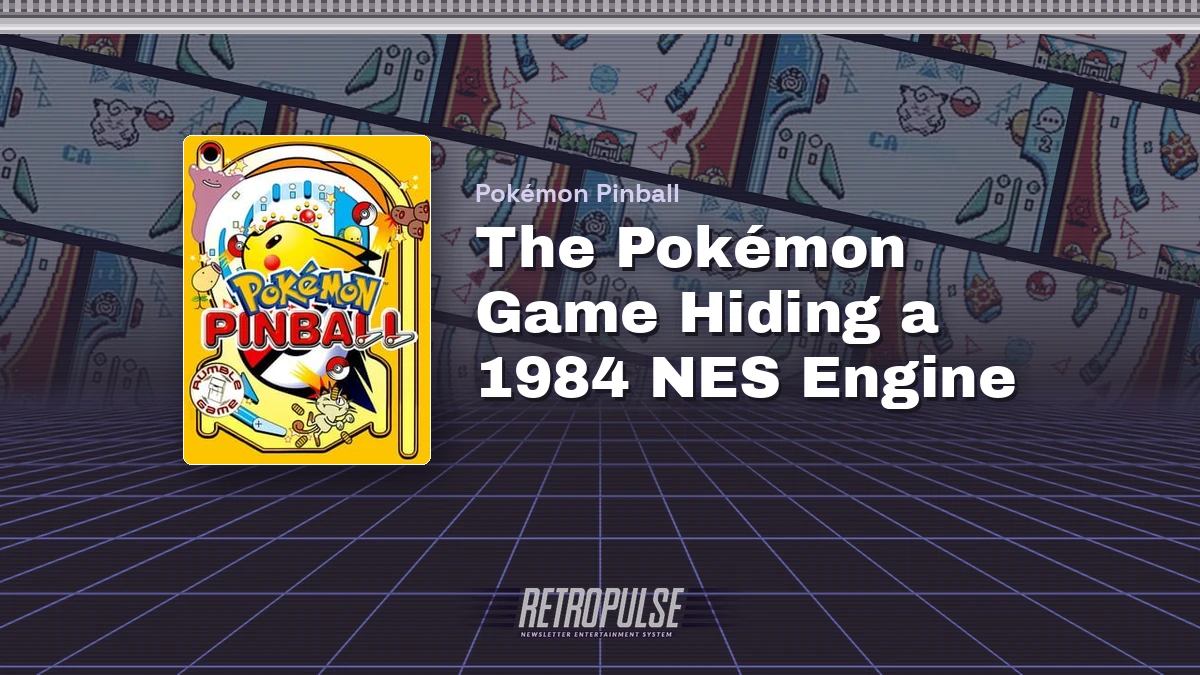
Pokémon Pinball has an older game under the hood. In a 1999 interview, Satoru Iwata, then president of HAL Laboratory, said he was so proud of how well the 1984 NES game Pinball replicated a real machine that its basic engine was reused for Pokémon Pinball. HAL had already made pinball games for the Game Boy, and this one was a collaboration with the studio Jupiter.
The cartridge hides something too, in a more literal sense. It was the first Game Boy game with rumble, so the cartridge has an unusual shape, holding a vibration motor and a slot for one AAA battery. The idea came from Jupiter's founder, Makoto Nakayama, who wanted to bring the Nintendo 64's Rumble Pak to the Game Boy. His first thought for a rumbling pinball game was Metroid. Pokémon won because of its popularity in Japan, which is probably the right call for a game about catching things in balls.

The fastest-selling Game Boy game of its time
It came out in Japan on April 14, 1999, and in North America on June 29. It sold 262,000 copies in its first 20 days, making it the fastest-selling Game Boy title at the time, and it finished 1999 as the fourth best-selling video game in the United States, behind only Pokémon Red, Blue and Yellow. In the United Kingdom it earned a Gold award for selling at least 200,000 copies.
The rumble got plenty of attention. The New York Times called it innovative and predicted other developers would follow, while GameSpot dismissed it as "a nice novelty" but "a waste [...] of an AAA battery". Reviews overall were good, with an 81.73% average on GameRankings, and CNET called it "more than a shameless cash-in on the Pokémon phenomenon". A Game Boy Advance sequel, Pokémon Pinball: Ruby & Sapphire, followed in 2003, again from Jupiter.
Catch 'em all with a flipper
Pinball comes first, but the real goal is to fill your Pokédex with all 151 Pokémon, and it saves between games, so you can build it up over many sessions. Each table has locations that decide which Pokémon can appear. A slot machine picks your starting spot, and each table has its own way of moving you on to the next one.
Catch Mode is the heart of it. Once triggered, you have two minutes to hit the pop bumpers six times, each hit revealing a sixth of the Pokémon's picture, and then the Pokémon itself appears on the table and has to be hit four times. Evolution Mode works similarly: you pick something you caught this game, collect three items hidden behind the targets, and sink the ball in the center hole to evolve it, which is the only way to get the evolved form into your Pokédex. You need both tables to complete it, so the Red and Blue split works much like the main games.
Two tables in Kanto colors
The presentation was a selling point from the start, with GameSpot singling out how well it uses the Game Boy Color's screen. The Red Table moves through places like Pallet Town and Viridian Forest, while the Blue Table has Mt. Moon and Celadon City among its stops, and late in a run special maps such as the Safari Zone open up, with Indigo Plateau as the final one.

The physics drew complaints. GameSpot criticized them as poor and CNET called them incorrect, while also grumbling about gratuitous Pikachu appearances. (There is no such thing as a gratuitous Pikachu appearance, but fine.)
Anime songs and Gold and Silver previews
The soundtrack hides more than it shows. The Red Table plays an arrangement of a town theme from the original Pokémon games, and the Blue Table uses melodies that later turned up in Pokémon Gold and Silver, and the high score screen uses early versions of music from those games. Most strikingly, the Blue Table's catch music arranges Mezase Pokémon Master, the Japanese theme song of the anime, and since the game wasn't a tie-in, the tune stayed in the overseas versions too. It's the only time that song has been used as game music.
Bonus stages, Mewtwo and a Mew you can't catch
Completing catches and evolutions lights up the bonus counter, and three lights send you to a bonus stage. The Red Table's first is a field of Diglett you knock back into their holes before Dugtrio appears, and its second is a graveyard of Gastly, Haunter and finally Gengar. The Blue Table has Meowth scattering coins and Seel popping out of a pool. Both tables share the toughest one, Mewtwo, who has to be hit 21 or 23 times through a ring of orbiting barriers within two minutes.
Beat the Mewtwo stage twice and Mew can appear at Indigo Plateau, but it can't really be caught. A hidden counter means it would take 1,024 hits in a two-minute window, which is basically impossible, and only its Pokédex entry unlocks when you meet it.
Still a great pocket pinball table
Pokémon Pinball is a smart idea done well. The physics aren't perfect, but the catching and evolving give every ball a purpose, and the two tables keep you coming back. Players still remember it fondly, some calling it the best thing they played on the Game Boy Color. If you play the original cartridge, the rumble still needs that AAA battery.