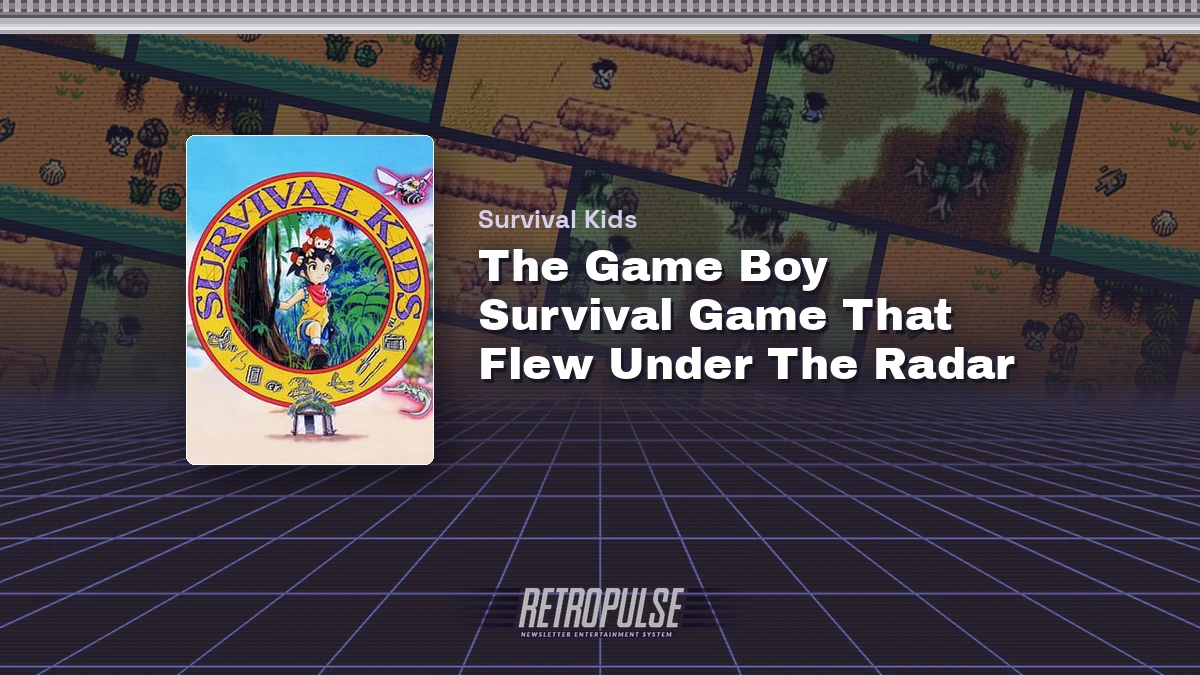
Survival Kids built a survival game on a small scale years before the genre became a popular standard, and it did it on a Game Boy Color cartridge in 1999. You eat, you drink, you nap in hollow trees and you build your own tools from whatever you find. Despite that, the game didn't get its first official re-release until May 23, 2025.
Its story starts with a birthday present that goes badly. Your character, a ten-year-old who dreams of becoming an adventurer like their father, sets out on a boat trip with him to celebrate, and then a storm capsizes the boat. You wake up alone on a deserted island with a knife and a broken radio, and the father vanishes from the story until one particular ending tells you he survived.

The start of Lost in Blue
Konami Computer Entertainment Sapporo made it, and Konami released it in Japan on June 17, 1999, in North America that November and in Europe that December under the name Stranded Kids. In Japan it became the first game in the Survival Kids series, which later reached North America and Europe as Lost in Blue. A Game Boy Color sequel followed in 2000, then a run of DS games from 2005, and the name even returned for a Switch 2 launch game in June 2025, although that one has very little in common with the originals.
The first game never found a big audience, however. It made a list of the best undiscovered Game Boy and Game Boy Color games, and players who did find it tend to call it a hidden gem that most people never heard of. At the time, critics were mostly impressed: IGN gave it 9 out of 10, while Game Informer and Nintendo Power scored it in the sevens. Later, looking back, Nintendo Power called it "inventive" and worth a "second look".
Merge two sticks and make a plan
The heart of the game is merging. Almost everything on the island can be picked up, and most of it is useless on its own, so you combine two or three objects into tools, weapons and other gear. A vine and a flexible branch make a bow. A stick, a bird feather and a pointed rock make arrows, and the flexible branch plus a line of fishing gut you discover makes a fishing rod. Working out these recipes is half the fun.
Your tools wear out, however. Kindling, arrows and torches degrade until they break, so you are always making replacements, and meat goes rotten within a single in-game day unless you cook it and merge it with a plant that works as a spice. There are about 15 kinds of plants on the island, and their effects get shuffled with every new game, so the mushroom that fed you last time might poison you this time. Even so, the game never gets too punishing; keeping yourself fed and rested is a rhythm rather than a constant emergency.
An island drawn like a Zelda game
Visually it borrows the look of the big adventure games of its generation. The overhead 2D view recalls The Legend of Zelda and Pokémon, and the real-time encounters make it feel closer to Zelda than to a typical RPG. Meanwhile, the simulation side brings a little Harvest Moon into the mix, with weather and the time of day changing what you can do and how your items behave.

It isn't a showpiece, but it is pleasant to look at and to listen to. Sand and forest come in warm, readable colors, which matters when you are scanning the ground for a sharp rock.

The music came from Atsushi Fujio and Yasuhiro Ichihashi, and like the visuals it supports the mood rather than demanding attention, which suits a game where most of your time goes into foraging. It's the soundtrack of a long afternoon of looking for berries, and that is meant as a compliment.
A monkey, a stranger and a pile of endings
Beyond the meters, the island has company. A wild monkey called Lucky starts out by stealing your backpack, but once you rescue it from the wreckage of a house flattened by a storm, it becomes your friend, follows you everywhere and fetches items for you. It also matters more than it looks. Skip the rescue and the first escape attempt ends badly. (Lesson learned: always save the thief.)
Then there is the other kid. Whichever child you don't choose as your hero is also stranded on the island, weak and unprepared, and you find them collapsed and help them, after which they wait at an old ship that becomes your second base. Feeding them raises their affection, and whether you met them, and how much they like you, decides between endings where you live on the island together, where they die during the escape, or where the two of you marry later in life.

The structure is open from the start. There are no set goals beyond staying alive, and the ending you get depends on your discoveries and your crafting, as well as where things stand after a certain amount of time. As a result, you can finish it several times without seeing the same conclusion.
The forgotten pioneer, finally on Switch
Survival Kids is a small game with a big idea. Players today keep pointing out that it was doing survival crafting long before anyone called it a genre, and they're right. The visuals are modest, yet the island holds up because every system feeds the next one.
If you want to play it now, it's part of the Game Boy library in Nintendo Classics on the Switch, which is exactly where a game this far ahead of its time should finally be easy to find.