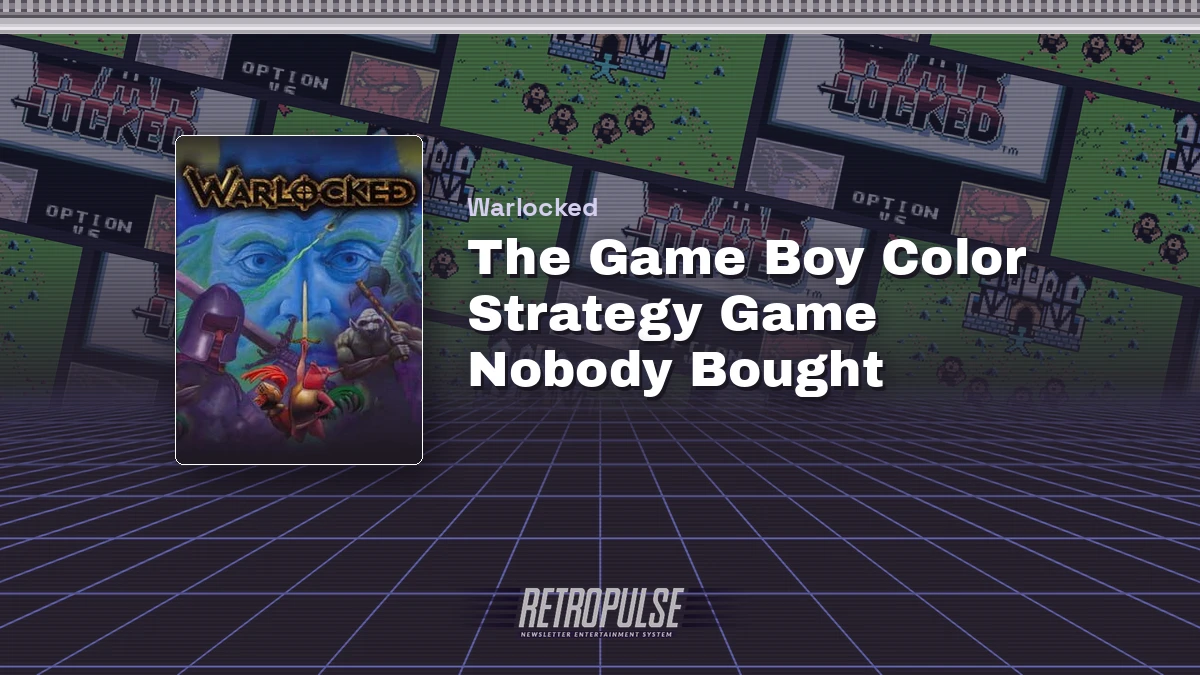
Warlocked is a real-time strategy game on the Game Boy Color, which still sounds like a dare. Nintendo published it only in North America, on July 24, 2000, and critics were impressed enough that IGN named it the best Game Boy strategy game of the year. Sales, however, were low, so the most ambitious game on the system quietly disappeared.
Its developer had an odd history, too. Bits Studios, a British team, had spent most of its first decade turning out poorly received games, from Last Action Hero to the Itchy & Scratchy Game, before Nintendo of America signed it up. With that deal behind it, Bits set out to squeeze Warcraft onto a handheld, and it very nearly got away with it.

Bits Studios gets its big Nintendo shot
Under the Nintendo deal, Bits first released R-Type DX in 1999, a Game Boy Color update of its earlier R-Type ports. It also pitched Riqa, a Tomb Raider-style action game that Nintendo showed at E3 next to Perfect Dark and Eternal Darkness, but that one was delayed repeatedly and finally canceled. Warlocked, which began development in early 1999, was the project that made it out.
The game didn't save the partnership, however. Around the turn of the millennium Nintendo of America dropped many of its second-party developers, Bits among them, and the studio's planned Game Boy Advance sequel, Wizards, never found a publisher. It was meant to come out in 2003 with four-player battles and modes like capture the flag. Bits moved on to games such as Constantine before its parent company sold the studio off in 2008.
Warcraft on a Game Boy Color
There's no point pretending Warlocked hides its influence. The cover shows a human and an orc fighting, and you pick between the humans and the beasts, each with a campaign of twelve scenarios. Anyone who played a mid-nineties strategy game will know what to do: you point a cursor at units to give them orders, while your workers gather gold and lumber so you can build.
You only get three kinds of building. Barracks train warriors and archers, farms raise your unit limit, and guard towers fire arrows at anything that comes close. A fog of war hides the map until your troops explore it, and if your home base falls, the level is lost on the spot. The beast campaign is noticeably harder and comes with a shorter tutorial, so the game clearly expects you to start with the humans.
A palette that changes with the weather
The technical side is where Warlocked earns its reputation. The sprites are a reasonable size, there are often more than ten of them on screen at once, and the large maps scroll smoothly most of the time. The processor does strain sometimes and you'll notice slowdown, but it's remarkable how efficiently the game uses the hardware.

It's clever with color as well. Locations range from forests to tundras, and on a snowy level the whole palette seems to shift toward winter. Martin Wheeler handled both the graphics and the design, and his only other design credit is Sorcery, a classic of 1984 8-bit home computers.
Jeroen Tel's C64 sound on a handheld
The music came from Jeroen Tel, a veteran of the Commodore 64 demo scene, and Warlocked was the only game he worked on for Bits. His score is mostly medieval battle music with the occasional chiptune rocker, and it sounds a lot like his C64 work, especially in its heavy use of arpeggios. The digitized speech is unusually crisp too, possibly the clearest example of voice clips anywhere on the Game Boy.
Wizards, dragons and a pig
The real twist is the wizards. Each level hides one, usually guarded by a lot of enemies, and once captured they stay in your army for good, stored at a magic stone building near your base. Death is permanent for them, though, which makes every wizard precious. There are almost thirty, each with a short bio and a special ability. The Poxwiz spreads a disease that turns enemies green before they explode and pass it on, the Stealthwiz makes units invisible, and the Pigwiz, who escaped from Queen Azarel's banquet table, turns enemies into pigs. The humans get a Chickenwiz instead. (Every war needs a poultry option.)
Dragons are the other prize. Some levels hold a nest with an egg that hatches when a unit walks up to it, and if you lead the baby back to base, it grows into a dragon that only archers and wizards can hurt. Unless five archers or a few guard towers are nearby, a dragon barely notices the damage, which is why most levels are dotted with enemy archers and towers placed to stop you.
Most missions still come down to wiping out the enemy or their base, but each campaign also has a strange stealth level in which one or two workers sneak around setting off traps until they find a wizard to do the fighting. Scrolls scattered across the maps give hints and unlock extras, among them multiplayer maps, a poker game and sliding puzzles. Two players can battle over the Game Link Cable or trade wizards to complete their collections.
The only strategy game the system needed
Warlocked has real flaws. It runs too slowly, and the enemy AI is easy to exploit. Even so, on the Game Boy Color it plays like a technical achievement, and at its best it matches the old Dune II. Reviews averaged 86%, and some critics noted it was the only real-time strategy game on the handheld.
IGN even listed it in 2009 among the games it wanted on a Nintendo DSi Virtual Console, yet it never came back. Players still point to it as the Game Boy Color's answer to Warcraft, and since there is no modern release, the original cartridge on a Game Boy Color is still the way to play it.