The Saturn sold 9.26 million units, most of them in Japan, and it is considered a commercial failure. In North America it was discontinued in 1998, while Japan kept it going until 2000.
That split shapes everything about collecting it. Just 253 of the 1,028 Saturn games came out in North America, so the English-language shelf is short and much of it was printed in small numbers, while the Japanese library is deep and cheap.
Most Saturn games never left Japan
The Saturn did better in Japan than anywhere else, with 5.75 million units sold there against 1.8 million in the United States. Only 7 Saturn games were released in North America in 1998, compared to 119 in 1996, and Magic Knight Rayearth was the final official release.
So a Western Saturn collection is small by design. If you want the depth of the library, you will end up looking at Japanese discs sooner or later.
Every Saturn is region-locked, but a cartridge fixes it

The easiest way to play Japanese Saturn games is a Japanese Saturn. On an American or European console you usually need a region-bypass cartridge such as an Action Replay or Pseudo Saturn Kai, or a more advanced setup like an optical drive emulator or a region-free mod.
Region lock, 50/60Hz timing and cartridge RAM are separate problems, though, and the fix for one doesn't always fix the others. Some games also need a RAM expansion cartridge in the Saturn's cartridge slot, so check what an import needs before you buy it.
Change the clock battery, then back up your saves

The Saturn keeps saves in 32 KB of battery-backed memory, and the battery behind a panel on the back is a standard CR2032 watch battery that pops out with ease. If it is dead, the console asks you to set the time and date every time you switch it on.
A replacement battery costs a few dollars, so a used Saturn asking for the date isn't broken. Saves are the bigger worry, because that small internal memory fills quickly, and a memory cartridge in the slot is the safer home for anything long.
The Model 2 runs cooler
Japanese Model 2 units are increasingly sought because they run cooler and have fewer known failure modes than early Model 1 revisions. In a 2026 price guide, Japanese Saturns of either model typically ran $200 to $350 for decent units, while North American consoles in good condition ran $250 to $400.
European Saturns, in black plastic, commanded the highest premiums at $400 to $600 or more, because fewer survived in good condition, not because the hardware is better. Yellowed North American units can even be cheaper than Japanese ones with identical insides.
The American longboxes break if you look at them
North American Saturn games came in a double-tall, double-thick plastic jewel case with room for a big manual. The tall front cover is prone to splitting down the middle, and the large, thin hinges often shatter. For years replacements were impossible to buy, so many collectors swapped cases with a game of lesser value.
In Japan, Saturn games were simply sold in standard jewel cases, like music CDs. They survive far better, and that is part of why a complete Japanese copy is easy to find in good shape.
The famous games are cheap
The arcade conversions that sold the system cost very little. Loose Virtua Fighter 2 sold for a typical $10 in 2024, and so did Daytona USA, with boxed copies of each at a typical $27 and $30. NiGHTS into Dreams, one of the best-regarded Saturn games, went for a typical $31 loose in 2025.

That keeps the entry price of a Saturn shelf low. The trouble starts with the games that arrived as the system was disappearing.
The late releases are the expensive shelf
The Saturn games that cost real money came out as Sega was walking away from it. Panzer Dragoon Saga reached North America on May 5, 1998, one of the last Saturn games Sega published outside Japan. Sega initially produced only 20,000 North American copies, and after they sold out in two days, a few thousand more. In Europe, only around 1,000 copies were made.
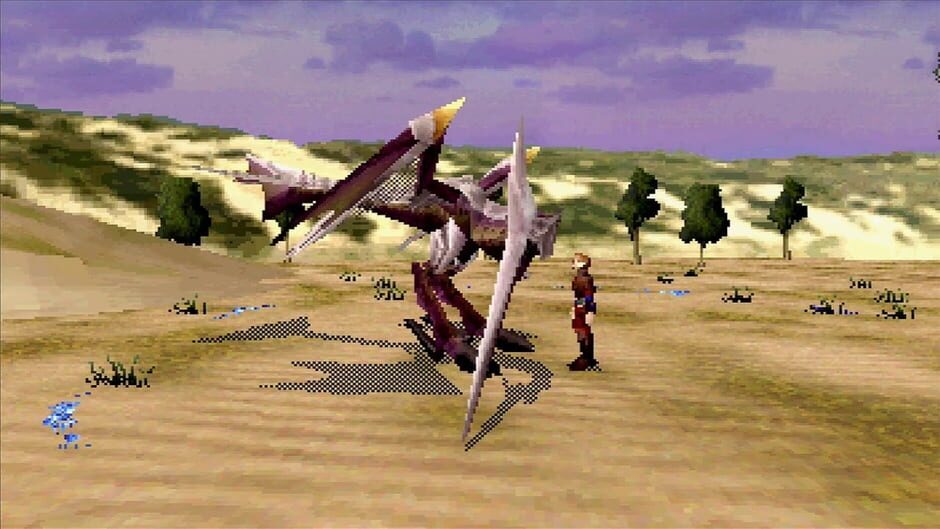
It spans four discs, and complete copies sold for a typical $1,238 from March to July 2026. Burning Rangers went for a typical $580 boxed in the first half of 2025, and Mega Man 8 for a typical $450 boxed. Magic Knight Rayearth, the final North American release, delayed for over two years, sold for a typical $948 boxed from late 2025 into early 2026.
Below those sits a middle tier. Shining Force III sold for a typical $185 loose in 2025, and Guardian Heroes went for a typical $87 loose and $203 boxed the same year: well above the arcade hits, well below the late releases.
Japan also got Saturns from other makers
Several Saturn models were produced in Japan, and two came from other companies: Hitachi released the Hi-Saturn, a smaller model with a car navigation function, and JVC released the V-Saturn. They play the same discs, and they are Japanese side roads for collectors who want the odd ones.
Even Sega's own early Japanese units have a premium. The single-colour launch consoles from 1994 are the same hardware as the later two-colour ones, yet in the 2026 price guide they commanded 15 to 25 percent more, simply because fewer people kept them.
Fake Saturn discs are uncommon, but check the ring
Fake Saturn discs were long uncommon because the console's security wasn't cracked, so only authentic discs would play. Authentic discs have writing in the inner ring, embedded in the disc itself rather than printed on the art, which a burned copy lacks.
So on any expensive Saturn game, ask for a photo of the disc's inner ring, and be wary of discs with no manual and a price that seems too good.
One high sale doesn't set the market
A retro store owner called the Saturn the most overhyped market he saw in October 2026: some owners see one unusually high sale and assume their whole collection has jumped in value. There are genuinely valuable Saturn games, but one outlier doesn't establish the market.
So look at several recent completed sales before you pay, or before you price your own. The typical sale is the real price; the record is a story (and Saturn collectors love a story).