The Switch shipped over 155 million units and became the second-best-selling console ever, behind only the PlayStation 2. It is also still a working platform: its successor plays its cartridges, and Nintendo says the eShop and its online service will continue for the foreseeable future.
So collecting the Switch is less about rescuing a dead machine and more about knowing which boxes hold a whole game, which games will never be cheap, and which small print runs have already gone.
Check the model number on an original Switch
The first Switch came out on March 3, 2017. In mid-August 2019 Nintendo released a revised version, model HAC-001(-01), with a more efficient chip that extended battery life to 4.5 to 9 hours, against 2.5 to 6.5 on the original. No other component changed, so the box looks almost the same.
There is a second difference that hackers care about. In April 2018, an exploit was found in the original Switch's chip that lets it boot other software, and it could not be patched by a software update. Nintendo quietly changed the hardware around July 2018 to block it. For a player, the later model's battery is the better buy.
The Lite and the OLED are different machines
Two revisions followed: the handheld-only Switch Lite on September 20, 2019, and a higher-end model with an OLED screen on October 8, 2021. The Lite can't connect to a TV, which is its whole trade-off.
Used prices in 2026 reflected that. GameStop listed pre-owned standard Switch consoles at around $200, OLED models at around $250 and the Lite at around $170. If you only play in your hands, the Lite is the cheapest way in.
A Switch 2 plays your Switch cartridges
The Switch 2 came out on June 5, 2025, and Nintendo designed it so people could keep playing the Switch software they already owned. It plays original Switch games through a mix of software and hardware emulation.
That matters for a collection. Your Switch cartridges aren't tied to aging hardware the way GameCube discs or Wii U discs are, and a shelf of them stays playable on Nintendo's current console.
Check what is actually on the card
Not every box holds a whole game. On the Switch 2, Game-Key Cards contain a download key rather than the full game data, and you need an internet connection when you first insert one. You can spot them by a key icon on the front of the box.
The same problem existed on some original Switch releases. When Minecraft: Story Mode was delisted on June 25, 2019, after Telltale Games closed, owners of physical copies learned that some carts held only the first episode, with the rest meant to be downloaded. For any game that came out in parts, check what is on the cartridge before you pay.
Every Switch plays every region
The Switch has no region lockout, so a Japanese or European cartridge works on an American console. That makes imports easy: if a game came out physically in Japan or Europe and not in your region, you can simply buy that version.
The one thing to check is the language, so look up the release before you import.
Test the Joy-Con for drift
Joy-Con drift was common enough that Nintendo of America stopped charging for repairs after the warranty expired, making all repairs of the controllers free. The free repair was later extended to Latin America.
On a used console, the controllers are the part most likely to be worn. Move both sticks slowly in a game or the system settings and watch for the cursor drifting when you let go.
Fake cartridges are scarce, flashcarts are not
Fake Switch games are far less common than fakes from the Game Boy or DS era. The piracy problem on the Switch is the flashcart instead, and in September 2026 a court in The Hague ruled that selling MIG Switch cards and MIG Dumpers is a crime.
For a collector, that means a used Switch game with a real label and case is almost certainly real. Be wary of consoles sold with a pile of unlabelled cards, though, because those cards are not a library.
Nintendo's own games barely drop in price
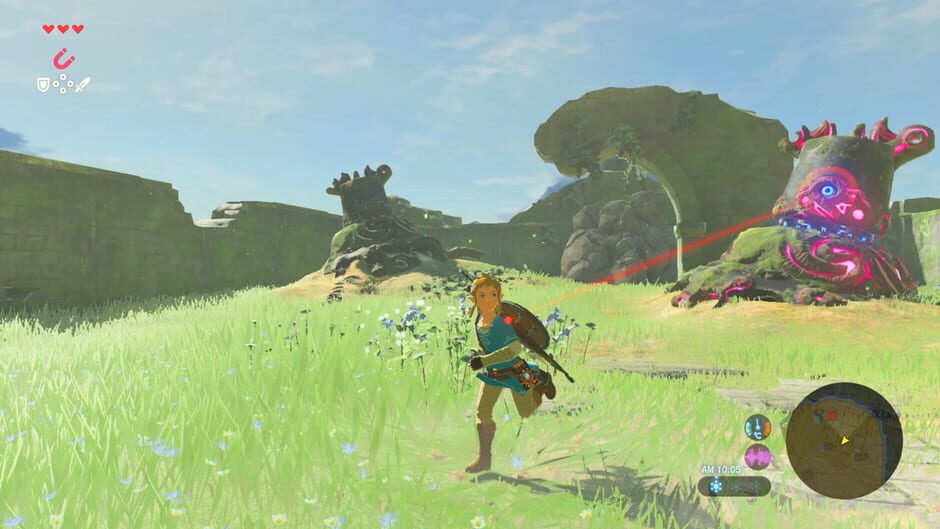
Nintendo's games keep their value unusually well, and the big ones sit at about the same price used. In August 2026, loose The Legend of Zelda: Breath of the Wild sold for a typical $30, Super Mario Odyssey for a typical $30, Mario Kart 8 Deluxe for a typical $32 and Super Smash Bros. Ultimate for a typical $35. Animal Crossing: New Horizons went for a typical $35 in September 2026.
That flat line cuts both ways. A first-party game you buy today won't get much cheaper, but it won't lose much if you sell it either. Pokémon Sword followed the same pattern, at a typical $30 loose in August 2025.
Delisted games live on the cartridge
When a game leaves the eShop, the cartridge becomes the only way to buy it. Minecraft: Story Mode left on June 25, 2019 because of Telltale's closure, and the physical Complete Adventure sold for a typical $90 loose in spring 2026, about three times a used Super Mario Odyssey.

So watch the news as well as the shelf. A game pulled from the shop over a licence or a closed studio is the one most likely to climb next.
The expensive shelf is small print runs and special editions
The costly Switch games are mostly physical releases made in small batches. Boxed Shantae and the Pirate's Curse sold for a typical $270 in the first half of 2025. In August 2025, a Limited Run Games variant of Bloodstained: Curse of the Moon from its 2019 Pop-Up Shop-Up event was worth up to $600 loose, with a different cover and exactly the same game.

Special editions are their own shelf. The Cult of the Lamb True Believer edition, with a signed art book and a plush among its extras, was valued at $650 without its extras and upwards of $800 complete. The game inside is the same one sold everywhere else, so buy these for the box or not at all.